Vieta's formulas relate a polynomial's coefficients to symmetric sums of its polynomial roots. Let
 be the sum of the products of distinct
polynomial roots
be the sum of the products of distinct
polynomial roots  of the polynomial equation
of degree
of the polynomial equation
of degree 
 |
(1)
|
where the roots are taken  at a time (i.e.,
  is defined as the symmetric
polynomial
is defined as the symmetric
polynomial  )
)
 is defined for
  , ...,
  . For example, the first few values of
  are
are
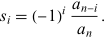
and so on. Then Vieta's formulas states that
 |
(5)
|
The theorem was proved by Viète (also known as Vieta, 1579) for positive roots only, and the general theorem was proved by Girard.
This can be seen for a second-degree polynomial
by multiplying out,
so
Similarly, for a third-degree polynomial,
so
See also
Newton-Girard Formulas,
Polynomial Discriminant,
Polynomial
Roots,
Symmetric Polynomial
Explore with Wolfram|Alpha
References
Bold, B. Famous Problems of Geometry and How to Solve Them. New York: Dover, p. 56,
1982.Borwein, P. and Erdélyi, T. "Newton's Identities."
§1.1.E.2 in Polynomials
and Polynomial Inequalities. New York: Springer-Verlag, pp. 5-6, 1995.Coolidge,
J. L. A
Treatise on Algebraic Plane Curves. New York: Dover, pp. 1-2, 1959.Girard,
A. Invention nouvelle en l'algèbre. Leiden, Netherlands: Bierens de
Haan, 1884.Hazewinkel, M. (Managing Ed.). Encyclopaedia
of Mathematics: An Updated and Annotated Translation of the Soviet "Mathematical
Encyclopaedia," Vol. 9. Dordrecht, Netherlands: Reidel, p. 416,
1988.Khovanskii, A. "Newton Polyhedra, a New Formula for Mixed
Volume, Product of Roots of a System of Equations." In The Arnoldfest: Proceedings
of a Conference in Honour of V. I. Arnold for His Sixtieth Birthday
(Ed. E. Bierstone, B. Khesin, A. Khovanskii, and J. E. Marsden).
Providence, RI: Amer. Math. Soc., pp. 325-364, 1999. https://www.math.toronto.edu/askold/newform.pdf.Soprounov,
I. "Residues and Tame Symbols on Toroidal Varieties." Compositio Math. 140,
1593-1613, 2004. https://doi.org/10.1112/S0010437X0400079X.van
der Waerden, B. L. Algebra,
Vol. 1. New York: Springer-Verlag, 1993.Viète, F.
Opera
mathematica. 1579. Reprinted Leiden, Netherlands, 1646.Referenced
on Wolfram|Alpha
Vieta's Formulas
Cite this as:
Weisstein, Eric W. "Vieta's Formulas."
From MathWorld--A Wolfram Resource. https://mathworld.wolfram.com/VietasFormulas.html
Subject classifications














![a_2[x^2-(r_1+r_2)x+r_1r_2],](/images/equations/VietasFormulas/Inline25.svg)







![a_3[x^3-(r_1+r_2+r_3)x^2+(r_1r_2+r_1r_3+r_2r_3)x-r_1r_2r_3],](/images/equations/VietasFormulas/Inline49.svg)





