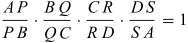
Carnot's polygon theorem is a product-of-ratios relation for intersections with the extended sides
of a polygon. In its spatial form, if a plane
meets the extended sides  ,
 ,
 , and
 of a skew quadrilateral
 at finite points
 ,
 ,
 , and
 , respectively, without containing a vertex,
then
where the bars denote signed lengths on consistently oriented
lines (Altshiller-Court 1979, p. 111).
For a planar polygon with vertices  ,
 ,
...,
 ,
set
 .
Suppose that an algebraic curve of polynomial
degree
 avoids the vertices, has none of the extended sides
as a component, and meets each extended side
 at
 finite points
 , ...,
 , counted with multiplicity.
Then
The identity follows by restricting a defining polynomial  to each extended side. The inner product is
 , and these ratios
telescope around the polygon.
For a triangle, the cases  and
 give Menelaus' theorem
and Carnot's conic theorem, respectively
(Szilasi 2012).
See also
Algebraic Curve,
Carnot's Conic Theorem,
Carnot's Theorem,
Carnot's
Theorems,
Menelaus' Theorem,
Polygon,
Skew Quadrilateral
Explore with Wolfram|Alpha
References
Altshiller-Court, N. "Carnot's Theorem." §329 in Modern
Pure Solid Geometry. New York: Chelsea, p. 111, 1979.Carnot,
L. N. M. Géométrie
de position. Paris, France: Duprat, p. 287, 1803.Carnot,
L. N. M. Mémoir sur la relation qui existe entre les distances
respectives de cinq points quelconques pris dans l'espace; suivi d'un Essai sur la
théorie des transversales. Paris, France: Courcier, p. 71, 1806.Casey,
J. A
Sequel to the First Six Books of the Elements of Euclid, Containing an Easy Introduction
to Modern Geometry with Numerous Examples, 5th ed., rev. enl. Dublin, Ireland:
Hodges, Figgis, & Co., p. 160, 1888.Coolidge, J. L. A
Treatise on Algebraic Plane Curves. New York: Dover, p. 190, 1959.Szilasi,
Z. "Two Applications of the Theorem of Carnot." Ann. Math. Inform. 40,
135-144, 2012. https://ami.uni-eszterhazy.hu/uploads/papers/finalpdf/AMI_40_from135to144.pdf.Referenced
on Wolfram|Alpha
Carnot's Polygon Theorem
Cite this as:
Weisstein, Eric W. "Carnot's Polygon Theorem."
From MathWorld--A Wolfram Resource. https://mathworld.wolfram.com/CarnotsPolygonTheorem.html
Subject classifications