

The Borchardt algorithm is an iteration of arithmetic means and geometric means that evaluates logarithms and inverse
trigonometric functions (Carlson 1971, 1972). For positive initial values  and
 , its recurrence is
 |  |  |
(1)
|
 |  |  |
(2)
|
The second step uses the newly computed  , unlike the ordinary arithmetic-geometric mean. Both sequences
converge to the common limit
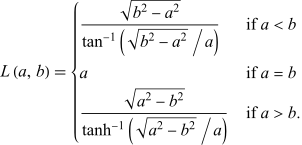 |
(3)
|
For unequal initial values, the errors of both sequences have limiting ratio  . The unaccelerated iteration therefore has linear
convergence, rather than the quadratic convergence of the ordinary arithmetic-geometric
mean (Carlson 1972).
For a real number  , the choice
 ,
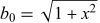 gives
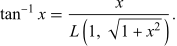 |
(4)
|
For  , the choice
 ,
 instead gives
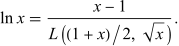 |
(5)
|
Carlson (1972) accelerates the iteration by extrapolating its successive values.
Taking reciprocals converts the iteration into a harmonic mean followed by a geometric mean. This is Archimedes' recurrence formula, used by the Archimedes algorithm to bound pi.
