

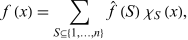
A Boolean Fourier expansion expresses a real-valued function on the sign set  as a linear combination
of the functions
 , indexed by subsets
 .
For a random variable
 with the discrete
uniform distribution on this set, the expansion is
 |
(1)
|
where its coefficients are
 |
(2)
|
The functions  form an orthonormal basis
for the inner product
 (O'Donnell 2021, pp. 24-25).
If  is a nonconstant Boolean function with values
in
 ,
its polynomial degree is the largest
 with
 . This is the total degree
of its representing multilinear polynomial
over
 .
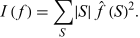
Its average sensitivity is (O'Donnell 2021,
p. 52)
 |
(3)
|
For example,  has just one nonzero coefficient,
 ,
and has polynomial degree and average
sensitivity equal to 2. The Gopalan-Servedio
conjecture concerns the coefficients
 .
