

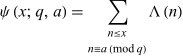
The Bombieri-Vinogradov theorem, also called Bombieri's theorem, describes the average distribution of prime numbers in arithmetic progressions. Define
 |
(1)
|
where
 |
(2)
|
(Davenport 1980, p. 121),  is the Mangoldt function,
and
is the Mangoldt function,
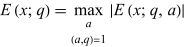
and  is the totient function. Now define
 |
(3)
|
where the maximum is over integers  relatively prime to
  ,
and
,
and
 |
(4)
|
Thus  is the largest absolute error for modulus
  , allowing both the endpoint
  and the reduced residue class
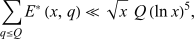
  to vary. The Bombieri-Vinogradov theorem then says that for
fixed
to vary. The Bombieri-Vinogradov theorem then says that for
fixed  ,
,
 |
(5)
|
provided that  .
.
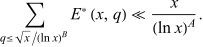
In particular, for every  , there is a
  such that
 |
(6)
|
Thus the theorem controls the average error for moduli up to essentially  . It was proved independently by Bombieri (1965) and
A. I. Vinogradov (1965). The Elliott-Halberstam
conjecture proposes the corresponding estimate with
. It was proved independently by Bombieri (1965) and
A. I. Vinogradov (1965). The Elliott-Halberstam
conjecture proposes the corresponding estimate with  replaced by
  for every
  .
.

 -Series" [Russian]. Izv. Akad. Nauk SSSR Ser. Mat. 29,
903-934, 1965; corrigendum 30, 719-720, 1966.
-Series" [Russian]. Izv. Akad. Nauk SSSR Ser. Mat. 29,
903-934, 1965; corrigendum 30, 719-720, 1966.