TOPICS
Search

Bifoliate Curve


Bifoliate

The bifoliate curve is the quartic curve given by the Cartesian equation

 x^4+y^4=2axy^2
(1)

and the polar equation

 r=(8costhetasin^2theta)/(3+cos(4theta))a
(2)

for theta in [0,pi].

It has a cusp at the origin (0,0).

BifoliateArea

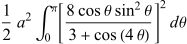
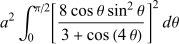
The area of the bifoliate is given by

A=1/2a^2int_0^pi[(8costhetasin^2theta)/(3+cos(4theta))]^2dtheta
(3)
=a^2int_0^(pi/2)[(8costhetasin^2theta)/(3+cos(4theta))]^2dtheta
(4)
=pi/(2sqrt(2))a^2
(5)
=1.110720...a^2
(6)

(OEIS A093954).

For a>0, the two loops have parametric equations

x=(2at^2)/(1+t^4)
(7)
y=(2at^3)/(1+t^4),
(8)

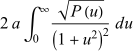
where 0<=t<infty traces the upper loop and -infty<t<=0 traces the lower loop. The total perimeter is

s=2aint_0^infty(sqrt(P(u)))/((1+u^2)^2)du
(9)
=6.4799119598464...a
(10)

(OEIS A118289), where u=t^2 and P(u)=u^5+4u^4-6u^3-8u^2+9u+4.

A closed form in Lauricella functions is

 s=8aF_D^((7))(1,b_1,...,b_7;3/2;z_1,...,z_7),
(11)

where b_1=...=b_5=-1/2, b_6=b_7=2, z_6=1+i, z_7=1-i, and z_1, ..., z_5 are the roots of

 4z^5-11z^4-4z^3+32z^2-24z+4=0.
(12)

The value uses the Euler integral representation with principal branches along 0<v<1. The substitution u=v/(1-v) gives this representation.

Taking t=theta as the parameter, the bifoliate has curvature and tangential angle given by

kappa(t)=(8sqrt(2)[3+cos(4t)]^3[3+2cos(2t)+cos(4t)]csct)/(a[182+174cos(2t)+152cos(4t)+19cos(6t)-14cos(8t)-cos(10t)]^(3/2))
(13)
phi(t)=tan^(-1)[(4costsint[3+cos(4t)])/(6+25cos(2t)+2cos(4t)-cos(6t))].
(14)

See also

Bifolium, Folium, Kepler's Folium, Quadrifolium, Rose Curve, Trifolium

Explore with Wolfram|Alpha

References

Cundy, H. and Rollett, A. Mathematical Models, 3rd ed. Stradbroke, England: Tarquin Pub., p. 72, 1989.Sloane, N. J. A. Sequences A093954 and A118289 in "The On-Line Encyclopedia of Integer Sequences."

Cite this as:

Weisstein, Eric W. "Bifoliate Curve." From MathWorld--A Wolfram Resource. https://mathworld.wolfram.com/BifoliateCurve.html

Subject classifications