TOPICS
Search

Dirichlet Integrals


The name "Dirichlet integral" is used for several types of integrals. The integral

 D[u]=int_Omega|del u|^2dV
(1)

appears in Dirichlet's principle.

The classical improper Dirichlet integral is

 int_0^infty(sinx)/xdx=pi/2.
(2)

For an integrable 2pi-periodic function f, the nth partial sum of its Fourier series is

 s_n(t)=1/(2pi)int_(-pi)^pif(x)(sin[(n+1/2)(t-x)])/(sin[1/2(t-x)])dx,
(3)

where n is a nonnegative integer and the quotient is the Dirichlet kernel, with its removable value 2n+1 at t-x=0 modulo 2pi.

For alpha>0 and real gamma, another Dirichlet integral is the symmetric Cauchy principal value

 delta(gamma)=1/piPVint_(-infty)^infty(sin(alpharho))/rhoe^(irhogamma)drho={0   for |gamma|>alpha; 1   for |gamma|<alpha; 1/2   for |gamma|=alpha.
(4)

There are two types of Dirichlet integrals which are denoted using the letters C, D, I, and J. The type 1 Dirichlet integrals are denoted I, J, and IJ, and the type 2 Dirichlet integrals are denoted C, D, and CD.

For the type 1 integrals, let Omega={(t_1,...,t_n):t_i>=0, sum_(i=1)^(n)t_i<=1}, Re(alpha_i)>0, and A=sum_(i=1)^(n)alpha_i. For a continuous function f on [0,1],

 I=int_Omegaf(t_1+...+t_n)product_(i=1)^nt_i^(alpha_i-1)dt_1...dt_n=(product_(i=1)^(n)Gamma(alpha_i))/(Gamma(A))int_0^1f(tau)tau^(A-1)dtau,
(5)

where Gamma is the gamma function. In the case n=2,

 I=intint_(T)x^py^qdxdy=(p!q!)/((p+q+2)!)=(B(p+1,q+1))/(p+q+2)
(6)

for nonnegative integers p and q, where the integration is over the triangle T bounded by the x-axis, y-axis, and line x+y=1 and B(x,y) is the beta function.

The type 2 integrals use a positive integer b, real numbers m>0 and r_i>0, and finite thresholds a_i>=0 for 1<=i<=b. Write R=sum_(i=1)^(b)r_i and K=Gamma(m+R)/[Gamma(m)product_(i=1)^(b)Gamma(r_i)]. The integrals are

C_(a)^((b))(r,m)=Kint_(Q_C)(product_(i=1)^(b)x_i^(r_i-1))/((1+sum_(i=1)^(b)x_i)^(m+R))dx_1...dx_b
(7)
D_(a)^((b))(r,m)=Kint_(Q_D)(product_(i=1)^(b)x_i^(r_i-1))/((1+sum_(i=1)^(b)x_i)^(m+R))dx_1...dx_b
(8)
CD_(a)^((c,b-c))(r,m)=Kint_(Q_c)(product_(i=1)^(b)x_i^(r_i-1))/((1+sum_(i=1)^(b)x_i)^(m+R))dx_1...dx_b,
(9)

where Q_C=product_(i=1)^(b)[0,a_i], Q_D=product_(i=1)^(b)[a_i,infty), and Q_c=product_(i=1)^(c)[0,a_i]×product_(i=c+1)^(b)[a_i,infty) for integers 0<=c<=b. Here the products of intervals denote Cartesian products. For c=0 the mixed integral is D, and for c=b it is C. The factor K normalizes the integral over [0,infty)^b to 1.

When the thresholds arise from cell probabilities, write p_0=1-sum_(i=1)^(b)p_i>0 and a_i=p_i/p_0. If all b+1 cell probabilities, including p_0, are equal, then a_i=1.

If the r_i are positive integers, the upper-tail integral has the finite sum

 D_(a)^((b))(r,m)=S^(-m)sum_(n_1=0)^(r_1-1)...sum_(n_b=0)^(r_b-1)(Gamma(m+N))/(Gamma(m)n_1!...n_b!)product_(i=1)^b((a_i)/S)^(n_i),
(10)

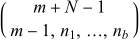
where S=1+sum_(i=1)^(b)a_i and N=sum_(i=1)^(b)n_i. For a positive integer m, the coefficient in this finite sum is the multinomial coefficient (m+N-1; m-1,n_1,...,n_b).
For one coordinate with unit threshold, write m=r_1 and r=(r_2). Then

C_1^((1))(r_2;r_1)=(Gamma(r_1+r_2)_2F_1(r_2,r_1+r_2;1+r_2;-1))/(r_2Gamma(r_1)Gamma(r_2))
(11)
D_1^((1))(r_2;r_1)=(Gamma(r_1+r_2)_2F_1(r_1,r_1+r_2;1+r_1;-1))/(r_1Gamma(r_1)Gamma(r_2)),
(12)

where r_1,r_2>0 and _2F_1 is the hypergeometric function. For two dimensions, write m=r_1, r=(r_2,r_3), T=r_1+r_2+r_3, and r_1,r_2,r_3>0. Then

C_((1,1))^((2))((r_2,r_3);r_1)=(Gamma(T))/(r_2Gamma(r_1)Gamma(r_2)Gamma(r_3))int_0^1y^(r_3-1)(1+y)^(-T)_2F_1(r_2,T;1+r_2;-1/(1+y))dy
(13)
D_((1,1))^((2))((r_2,r_3);r_1)=(Gamma(T))/((r_1+r_3)Gamma(r_1)Gamma(r_2)Gamma(r_3))int_1^inftyy^(r_3-1)_2F_1(r_1+r_3,T;1+r_1+r_3;-1-y)dy.
(14)

Explore with Wolfram|Alpha

References

Jeffreys, H. and Jeffreys, B. S. "Dirichlet Integrals." §15.08 in Methods of Mathematical Physics, 3rd ed. Cambridge, England: Cambridge University Press, pp. 468-470, 1988.Sobel, M.; Uppuluri, V. R. R.; and Frankowski, K. Selected Tables in Mathematical Statistics, Vol. 4: Dirichlet Distribution--Type 1. Providence, RI: Amer. Math. Soc., 1977.Sobel, M.; Uppuluri, V. R. R.; and Frankowski, K. Selected Tables in Mathematical Statistics, Vol. 9: Dirichlet Integrals of Type 2 and Their Applications. Providence, RI: Amer. Math. Soc., 1985.

Referenced on Wolfram|Alpha

Dirichlet Integrals

Cite this as:

Weisstein, Eric W. "Dirichlet Integrals." From MathWorld--A Wolfram Resource. https://mathworld.wolfram.com/DirichletIntegrals.html

Subject classifications








