


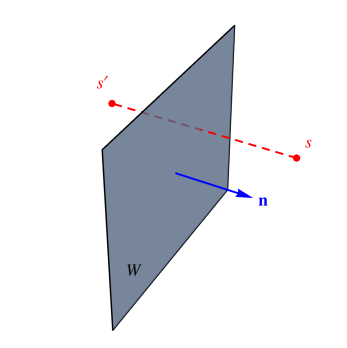
Let  be a
be a  -dimensional
vector space over
-dimensional
vector space over  , let
, let  , and let
 |
be a subspace of  of dimension
  , where
  is a unit normal
vector of
is a unit normal
vector of  .
Then
.
Then  is said to have mirror symmetry about
  if
if  contains the vector
 |
whenever it contains  .
The vector
.
The vector  is the mirror image of
  about
about  . For a plane figure,
  and the subspace
  is a line called an axis
of symmetry. For a geometric object in three-dimensional space, such as a surface or solid,
is a line called an axis
of symmetry. For a geometric object in three-dimensional space, such as a surface or solid,  and
and  is a plane of symmetry.
Mirror symmetry is sometimes called bilateral symmetry. Most animals are very nearly bilaterally symmetric. Molecules without bilateral symmetry come in two varieties denoted L (laevo) and R (dextro), each of which is the mirror image of the other. Such images are called enantiomers, and their property of being the same except by reflection is called handedness. Some highly symmetric geometric solids, including the snub cube and snub dodecahedron, also lack mirror symmetry and come in two enantiomorphous forms.
