

An autoregressive moving-average model of orders  and
and  , denoted
  , combines an autoregressive
model with a finite moving-average term. Let
, combines an autoregressive
model with a finite moving-average term. Let  be the shift operator defined
by
be the shift operator defined
by  .
For a centered time series, the model is
.
For a centered time series, the model is
 |
(1)
|
where
 |  |  |
(2)
|
 |  |  |
(3)
|
The  are uncorrelated innovations having population
mean zero and constant variance. A causal stationary
solution exists when every root of
are uncorrelated innovations having population
mean zero and constant variance. A causal stationary
solution exists when every root of  lies outside the unit circle,
and the model is invertible when every root of
lies outside the unit circle,
and the model is invertible when every root of  lies outside the unit circle.
For a causal model, the autocovariances
lies outside the unit circle.
For a causal model, the autocovariances  at lags
  obey
obey
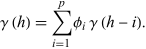 |
(4)
|
Dividing by  gives the corresponding autocorrelation
values.
gives the corresponding autocorrelation
values.
An autoregressive moving-average process can be represented in the Wolfram Language using ARMAProcess[a, b, v]. A seasonal autoregressive moving-average model adds autoregressive and moving-average terms at multiples of a seasonal period.
