

An anti-concentration inequality bounds the probability that a random variable lies in a short interval, or that a discrete random variable takes any one value. Such inequalities complement concentration inequalities, which bound the probability of lying far from a typical value.
A classical example is the Erdős-Littlewood-Offord inequality, which bounds the concentration of a signed sum of independent and identically distributed random signs.
There are also anti-concentration inequalities without independence. Let  , let
, let  be a uniformly random permutation,
and put
be a uniformly random permutation,
and put  .
If the coordinates of
.
If the coordinates of  are distinct and no coordinate
of
are distinct and no coordinate
of  occurs more than
  times, then
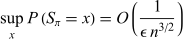 |
(Berger et al. 2026).
