

The Erdős-Littlewood-Offord inequality states that if  , ...,
  are real numbers satisfying
 ,
then at most the binomial coefficient
,
then at most the binomial coefficient  of the
  signed sums
  , where each
  , lie in any open
interval of length 2 (Erdős 1945).
, lie in any open
interval of length 2 (Erdős 1945).
Equivalently, if  , ...,
  are independent
and identically distributed random signs, each taking the values
are independent
and identically distributed random signs, each taking the values  and 1 with equal probability,
then for every open interval
and 1 with equal probability,
then for every open interval  of length 2,
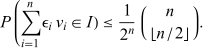 |
The inequality is sharp, as can be seen by taking  and choosing an open
interval containing a mode of the signed sum.
and choosing an open
interval containing a mode of the signed sum.
