


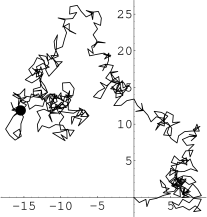
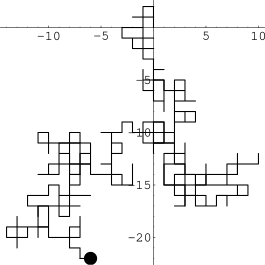
A 2-dimensional random walk has steps in a plane. For the walk illustrated above, consider a sum of  two-dimensional vectors with random
orientations. Use phasor notation, and let the phase of
each vector be random.
Assume
 unit steps are taken in an arbitrary direction (i.e., with the angle
 uniformly distributed in
 and not on a lattice),
as illustrated above. The position
 in the complex plane after
 steps is then given by
 |
(1)
|
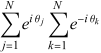
which has absolute square
 |  |  |
(2)
|
 |  |  |
(3)
|
 |  |  |
(4)
|
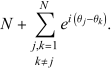
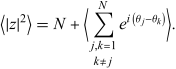
Therefore,
 |
(5)
|
Each unit step is equally likely to be in any direction ( and
 ).
The displacements are random variables with identical
means of zero, and their difference is also a random variable.
Averaging over this distribution, which has equally likely positive
and negative values yields an expectation value of 0,
so
 |
(6)
|
The root-mean-square distance after  unit steps is therefore
 |
(7)
|
so with a step size of  ,
this becomes
 |
(8)
|
In order to travel a distance  ,
 |
(9)
|
steps are therefore required.
The simple random walk on the square integer lattice  starts at the origin and chooses each of its four unit
steps with probability
 , independently at each time. This walk reaches every
lattice point with probability
1 and returns to the origin with probability
1 (McCrea and Whipple 1940).
Let  be the first time that every lattice point at distance
less than
 from the origin has been visited, where
 . For every
 ,
Dembo et al. (2004) proved the limiting distribution
function
 |
(10)
|
Thus the logarithm of the cover time has scale  .
The local time of a site at step  is the number of visits through step
 , including the visit at time 0. Write
 for the largest local time and
 for the set of favorite sites, those
attaining
 . Dembo et al. (2001) proved that
 almost surely.
Hao et al. (2026) proved that
 almost
surely. Three sites tie for the maximum infinitely often, and at most three do
so for all sufficiently large
 .
While the maximum local time stays fixed, any favorite site remains a favorite site. For each positive maximum level attained through step  , all sites that were favorite at that level are therefore
present at its last occurrence through step
 .
Apart from finitely many early levels, this counts at most three sites per level.
Consequently the number of distinct sites that have ever been favorite by step
 is
 almost surely. Here
 denotes big-O notation.
These results address problems 1164,
1165, and 1166
in the Erdős problems collection.
