

The  -binomial
coefficient is a two-parameter generalization of the
q-binomial coefficient. For nonnegative
integers
-binomial
coefficient is a two-parameter generalization of the
q-binomial coefficient. For nonnegative
integers  and
and  with
with  ,
it is defined by
,
it is defined by
![[n; k]_(p,q)=product_(i=1)^k(p^(n-i+1)-q^(n-i+1))/(p^i-q^i)=([n]_(p,q)!)/([k]_(p,q)![n-k]_(p,q)!),](/images/equations/pq-BinomialCoefficient/NumberedEquation1.svg) |
where, initially for  ,
, ![[j]_(p,q)=(p^j-q^j)/(p-q)](/images/equations/pq-BinomialCoefficient/Inline6.svg) , and the corresponding factorial
is
, and the corresponding factorial
is ![[j]_(p,q)!=[j]_(p,q)[j-1]_(p,q)...[1]_(p,q)](/images/equations/pq-BinomialCoefficient/Inline7.svg) .
After cancellation, the product and factorial quotient in the definition give the
same polynomial in
.
After cancellation, the product and factorial quotient in the definition give the
same polynomial in  and
and  . At parameter values for which a displayed denominator vanishes,
the coefficient is defined by the value of this polynomial continuation. The coefficient
is defined to be zero for
. At parameter values for which a displayed denominator vanishes,
the coefficient is defined by the value of this polynomial continuation. The coefficient
is defined to be zero for  (Corcino 2008).
It is symmetric under interchange of  and
and 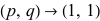 , reduces to the q-binomial
coefficient when
, reduces to the q-binomial
coefficient when  , and reduces to the binomial
coefficient in the limit
, and reduces to the binomial
coefficient in the limit  . It satisfies the recurrence
equation
. It satisfies the recurrence
equation
![[n+1; k]_(p,q)=p^k[n; k]_(p,q)+q^(n-k+1)[n; k-1]_(p,q).](/images/equations/pq-BinomialCoefficient/NumberedEquation2.svg) |

 -Binomial Coefficients." Integers 8, A29,
1-16, 2008.
-Binomial Coefficients." Integers 8, A29,
1-16, 2008.