

 -calculus is a two-parameter
extension of q-calculus based on the
-calculus is a two-parameter
extension of q-calculus based on the  -derivative of a function
  , defined by
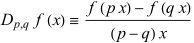 |
for  and
and  . At
. At  ,
,  is defined to be
  when this derivative exists. On monomials,
![D_(p,q)x^n=[n]_(p,q)x^(n-1), [n]_(p,q)=(p^n-q^n)/(p-q).](/images/equations/pq-Calculus/NumberedEquation2.svg) |
The quantity ![[n]_(p,q)](/images/equations/pq-Calculus/Inline9.svg) is called a twin-basic number. Setting
is called a twin-basic number. Setting  gives the q-derivative,
while the limit
gives the q-derivative,
while the limit 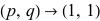 gives the ordinary derivative.
Associated
gives the ordinary derivative.
Associated  -integrals, Taylor formulas,
and an analogue of the fundamental
theorem of calculus can also be defined (Njionou Sadjang 2018).
-integrals, Taylor formulas,
and an analogue of the fundamental
theorem of calculus can also be defined (Njionou Sadjang 2018).

 -Calculus and Some
  -Taylor Formulas." Results Math. 73,
39, 2018.
-Taylor Formulas." Results Math. 73,
39, 2018.