

The virial theorem relates time-averaged kinetic energy to the forces in a mechanical system. For particles with positions  , momenta
 , and differentiable
potential energy
 ,
define
 and
 .
Newton's equations give
 |
(1)
|
If the time averages exist and  as
 , then
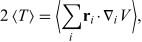 |
(2)
|
where  denotes a time average. Bounded
 is a sufficient condition for the boundary term to vanish
(Fowler).
If  is a homogeneous function of degree
 , so that
 for
 , differentiating with respect to
 gives
 . Consequently,
 |
(3)
|
For Newtonian gravitational attraction,  and
 . For a quadratic potential,
 and the time-averaged kinetic and potential energies are
equal. These conclusions require the averaging and boundary-term hypotheses; they
do not apply to an arbitrary instantaneous state.
