

Let  be a polynomial sequence, and let
  be linear
functionals on the space of polynomials. The sequence is
be linear
functionals on the space of polynomials. The sequence is  -orthogonal with respect to
 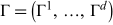 if
if
 |
(1)
|
and
 |
(2)
|
for  and
and  ,
2, ...,
,
2, ...,  .
The first conditions are the
.
The first conditions are the  -orthogonality conditions, while the second are regularity
conditions. Ordinary orthogonal polynomials
are recovered when
-orthogonality conditions, while the second are regularity
conditions. Ordinary orthogonal polynomials
are recovered when  .
.
A generalized Favard theorem states that a monic polynomial sequence is  -orthogonal iff it satisfies the initial conditions
  ,
, 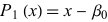 , and, for
  ,
,
 |  |  |
(3)
|
and the recurrence relation
 |
(4)
|
where  for
for  (Maroni 1989). For
  , this becomes the usual three-term recurrence for orthogonal
polynomials.
, this becomes the usual three-term recurrence for orthogonal
polynomials.
A polynomial sequence is called  -symmetric if
 |
(5)
|
where  is a root of unity. For a
  -orthogonal monic sequence,
  -symmetry is equivalent to
 |  | 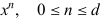 |
(6)
|
 |  |  |
(7)
|
It also gives the decomposition
![P_((d+1)k+mu)(x)=x^muP_k^([mu+1])(x^(d+1)), mu=0,1,...,d.](/images/equations/d-OrthogonalPolynomial/NumberedEquation5.svg) |
(8)
|
Consequently, the nonzero roots occur in orbits under multiplication by the  st
roots of unity, and the coefficients in the canonical basis vanish unless their exponents
are congruent to the degree modulo
st
roots of unity, and the coefficients in the canonical basis vanish unless their exponents
are congruent to the degree modulo  (Douak and Maroni 1992, Mesquita and da Rocha 2026).

 -Orthogonal Polynomials in Terms of Orthogonal Polynomials
and the Canonical Basis." Math. Comput. Sci. 20, #15, 2026.
-Orthogonal Polynomials in Terms of Orthogonal Polynomials
and the Canonical Basis." Math. Comput. Sci. 20, #15, 2026.