


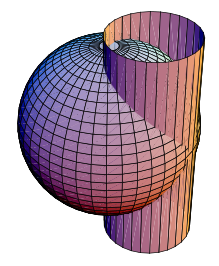
Viviani's curve, sometimes also called Viviani's window, is the space curve giving the intersection (Gray 1997, p. 201) of the cylinder
of radius  and center

 |
(1)
|
and the sphere
 |
(2)
|
with center  and radius
 . This curve was studied by Viviani in 1692 (Teixeira
1908-1915, pp. 311-320; Struik 1988, pp. 10-11; Gray 1997, p. 201).
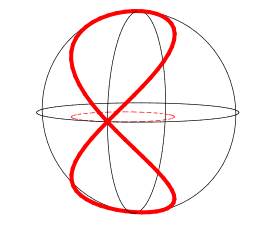
Solving directly for  and
 as a function of
 gives
 |  |  |
(3)
|
 |  |  |
(4)
|
This curve is given by the parametric equations
 |  |  |
(5)
|
 |  |  |
(6)
|
 |  |  |
(7)
|
for  (Gray 1997, p. 201).
Viviani's curve is a hippopede of Eudoxus whose defining cylinder has radius half that of its sphere (Ferréol).
Viviani's curve is the clelia with angular-speed ratio  on a sphere
of radius
 . The clelia parameter equals
 in the parametrization above (Ferréol).
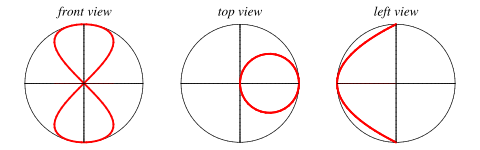
From the parametric equations, it can be immediately seen that views of the curve from the front, top, and left are given by a lemniscate-like curve, circle, and parabolic segment, respectively. The lemniscate-like figure has parametric equations
 |  |  |
(8)
|
 |  |  |
(9)
|
which can be written in Cartesian coordinates as the quartic curve
 |
(10)
|
Viviani's curve has arc length
 |
(11)
|
where  is a complete elliptic integral
of the second kind.
The arc length function, curvature, and torsion of Viviani's curve are given by
 |  |  |
(12)
|
 |  |  |
(13)
|
 |  |  |
(14)
|
(Gray 1997, p. 202), where  is an incomplete elliptic
integral of the second kind.

Viviani's curve is also a cone-sphere intersection, as illustrated above. In the coordinates above, its points
satisfy  , the equation of a cone
with vertex
 and axis parallel to the
 -axis. Subtracting this equation from that of the sphere
recovers the defining cylinder (Ferréol).
