


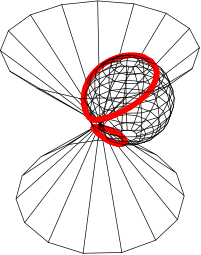
|
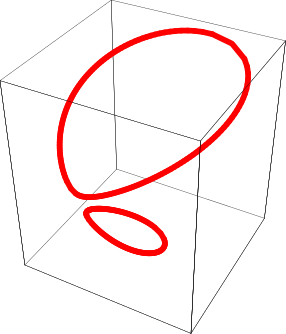
|
A cone-sphere intersection is the common locus of a cone and a sphere. Let a cone of opening
parameter  and vertex at
 intersect a sphere of radius
 centered at
 ,
with the cone oriented such that its axis does not pass
through the center of the sphere. Then the equations of
the curve of intersection are
 |  |  |
(1)
|
 |  |  |
(2)
|
On the upper nappe  ,
combining (1) and (2) gives
 |
(3)
|
 |
(4)
|
Squaring to eliminate the remaining square root gives a quartic equation in  and
 ; its solutions must still satisfy the unsquared equation and
the chosen nappe restriction.
An alternative parameterization follows by rotating about the  -axis until the center of the sphere
is
 , with
 .
Subtracting the two surface equations gives
 |
(5)
|
and the intersection of the double cone and sphere is
 |  |  |
(6)
|
 |  |  |
(7)
|
for real  with
 . A single nappe imposes its corresponding
sign restriction on
 .
The quadratic expression for
 does not make this space curve a conic
section.
If the cone-sphere intersection is on-axis so that a cone of opening parameter  and vertex at
 is oriented with its axis along a radial of the sphere
of radius
 centered at
 , then the equations of the curve of intersection
are
 |  |  |
(8)
|
 |  |  |
(9)
|
 |
(10)
|
 |
(11)
|
 |
(12)
|
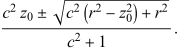
Using the quadratic equation gives
 |  |  |
(13)
|
 |  |  |
(14)
|
Each distinct real value of  gives a circle in a plane
perpendicular to the axis, with radius
 |
(15)
|
A zero radius gives a single point. Thus the double cone can intersect the sphere
in two circles lying in different planes;
a single nappe retains only the admissible values of  (for example,
 for the upper nappe). When the discriminant
is negative, the intersection is empty.
Viviani's curve is a special cone-sphere intersection. For  , it is the intersection of
 |  |  |
(16)
|
 |  |  |
(17)
|
Eliminating  gives
 , the defining cylinder
of Viviani's curve (Ferréol). Here the cone has vertex
 and an axis parallel to the
 -axis.
