


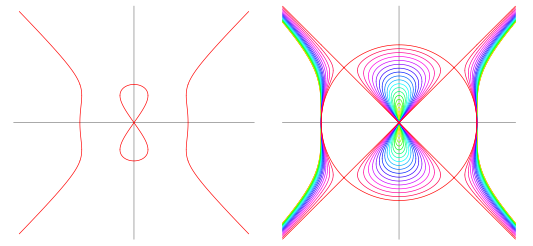
The devil's curve was studied by G. Cramer in 1750 and Lacroix in 1810 (MacTutor Archive). It appeared in Nouvelles Annales in 1858. The Cartesian equation is
 |
(1)
|
equivalent to
 |
(2)
|
the polar equation is
 |
(3)
|
and the parametric equations are
 |  | 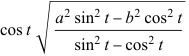 |
(4)
|
 |  | 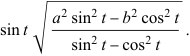 |
(5)
|
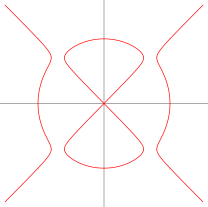
The curve illustrated above corresponds to parameters  and
and  .
.
It has a crunode at the origin.
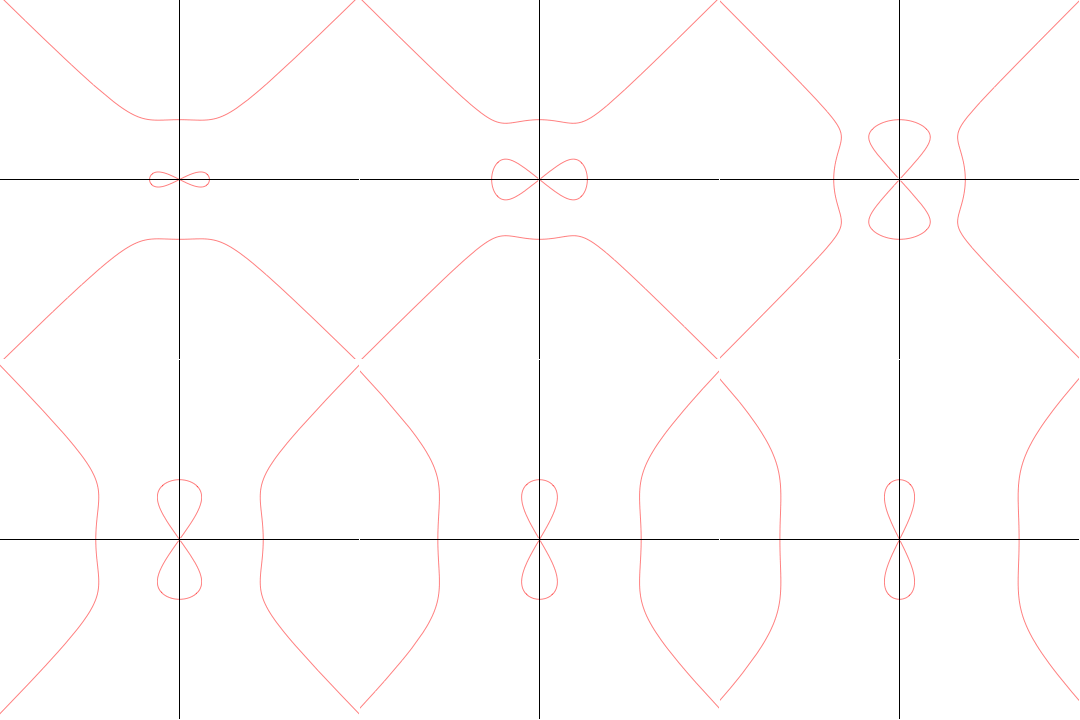
For  , the central hourglass
is vertical, while for
, the central hourglass
is vertical, while for  ,
it is horizontal. When
,
it is horizontal. When  ,
the equation factors as
,
the equation factors as
 |
(6)
|
so the degenerate curve is a circle together with the two diagonal lines  .
.
Let  and
and  , with
  . The two bounded lobes
have total area
. The two bounded lobes
have total area
 |
(7)
|
Each lobe has area  . The other real branches are unbounded and are not included.
As
. The other real branches are unbounded and are not included.
As  , this expression has limit
  , which is the limit
of the two selected lobes rather than the area of the entire
disk. (E. Weisstein, Sep. 23, 2026).
, which is the limit
of the two selected lobes rather than the area of the entire
disk. (E. Weisstein, Sep. 23, 2026).
The total perimeter  of the same two bounded lobes
can be written using a six-variable Lauricella
function. Set
of the same two bounded lobes
can be written using a six-variable Lauricella
function. Set  and
and
 |
(8)
|
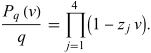
and define  ,
without choosing an ordering, by
,
without choosing an ordering, by
 |
(9)
|
Then
 |
(10)
|
(E. Weisstein, Sep. 23, 2026). Here the Lauricella function is taken on the explicit Euler integral branch
 |
(11)
|
For the expression for  ,
the product of the first four square root factors
is chosen to be the positive real value
,
the product of the first four square root factors
is chosen to be the positive real value  on
on  . The remaining factors
  and
and  are positive there, and
  . Thus this branch gives a finite real length for
the bounded lobes only, not for the unbounded branches.
. Thus this branch gives a finite real length for
the bounded lobes only, not for the unbounded branches.
A special case of the Devil's curve is the so-called "electric motor curve":
 |
(12)
|
(Cundy and Rollett 1989).
