

The vanishing conjecture states that for every homogeneous polynomial  of polynomial degree 4,
  for every integer
  implies
 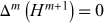 for all sufficiently
large
for all sufficiently
large  ,
where
,
where 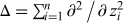 is the laplacian.
Zhao (2007) proved that the vanishing conjecture in every dimension is equivalent to the Jacobian conjecture in every dimension. The counterexample in dimension 3 that refuted the Jacobian conjecture in 2026 therefore shows that the vanishing conjecture is false in some finite dimension, although the equivalence does not identify the smallest such dimension (Zhang 2026).
The generalized vanishing conjecture permits arbitrary constant-coefficient differential
operators. Its three-variable counterexample
uses  ,
rather than
,
rather than  ,
and therefore does not identify a dimension in which
the vanishing conjecture fails (van Rijn 2026).
,
and therefore does not identify a dimension in which
the vanishing conjecture fails (van Rijn 2026).
