


The Jacobian conjecture asserts that a polynomial map  having a nonzero
constant Jacobian determinant
is an automorphism. The plane statement appeared
as the purported main result of a flawed proof by Kraus (1884), more than half a
century before Keller (1939) posed the problem (Rodríguez Díaz 2026).
Equivalently, in two dimensions it asserts that a ring
homomorphism
having a nonzero
constant Jacobian determinant
is an automorphism. The plane statement appeared
as the purported main result of a flawed proof by Kraus (1884), more than half a
century before Keller (1939) posed the problem (Rodríguez Díaz 2026).
Equivalently, in two dimensions it asserts that a ring
homomorphism  from
from ![C[x,y]](/images/equations/JacobianConjecture/Inline3.svg) (the polynomial ring in two variables over the
complex numbers) to itself that fixes
(the polynomial ring in two variables over the
complex numbers) to itself that fixes  and sends
  ,
,  to
to  ,
,  , respectively, is an automorphism iff the Jacobian
  is a nonzero constant.
The condition is easily shown to be necessary.
is a nonzero constant.
The condition is easily shown to be necessary.
There have been at least five published incorrect proofs and many incorrect attempts over the years (cf. Hochster 2004, Woit 2004).
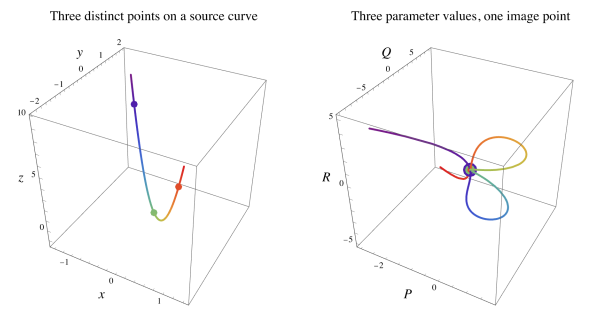
In July 2026, Alpöge (2026) announced the following polynomial counterexample, which he credited to Anthropic's Claude Fable 5 AI model (Stark-Elster
2026). Writing  ,
its coordinate polynomials are
,
its coordinate polynomials are
 |  |  |
(1)
|
 |  |  |
(2)
|
 |  |  |
(3)
|
The determinant of its Jacobian matrix  is the nonzero constant
 |
(4)
|
but the three distinct points
 |
(5)
|
have the same image, since
 |
(6)
|
Therefore, the Jacobian conjecture is false in dimension 3 and, by adjoining identity coordinates, in every dimension  , while the plane case remains open (Zhang 2026).
The inverse function theorem guarantees a local inverse function at every point, but does not guarantee a global inverse function. As a target point varies, points of a fiber cannot merge at a finite point, since this would contradict local invertibility. They can instead escape to infinity while their images remain bounded. Thus the counterexample is not a proper morphism, and the number of points in its fibers can change without the Jacobian determinant vanishing (Gallagher 2026, §3).
Gallagher (2026) constructed an infinite family of polynomial maps  with nonzero constant Jacobian determinant for which the number of points in a fiber
over a point outside a proper algebraic set in the
target takes every integer value
with nonzero constant Jacobian determinant for which the number of points in a fiber
over a point outside a proper algebraic set in the
target takes every integer value  . This number is the degree
of the induced function field extension, rather
than the maximum polynomial degree of the coordinates.
Gao (2026) explained the construction using tangent lines
to a plane curve and generalized it to obtain counterexamples
of arbitrarily large function field degree
in every dimension greater than 2.
. This number is the degree
of the induced function field extension, rather
than the maximum polynomial degree of the coordinates.
Gao (2026) explained the construction using tangent lines
to a plane curve and generalized it to obtain counterexamples
of arbitrarily large function field degree
in every dimension greater than 2.
The function field degree is unchanged by coordinate changes given by invertible
polynomial maps in the source or target, and multiplies under function
composition. The original counterexample has function
field degree 3, so its  -fold function composition
has function field degree
-fold function composition
has function field degree  . Gallagher's example of function
field degree 4 therefore cannot be obtained
from the original counterexample by such coordinate changes or by iteration
(Gallagher 2026, §9).
. Gallagher's example of function
field degree 4 therefore cannot be obtained
from the original counterexample by such coordinate changes or by iteration
(Gallagher 2026, §9).
Van Dobben de Bruyn (2026, Appendix A) gave a coordinate-free explanation of the original counterexample by restricting a map  , where
  denotes projective space,
to suitable open subsets of the source and target. Both
subsets are isomorphic to affine
space
denotes projective space,
to suitable open subsets of the source and target. Both
subsets are isomorphic to affine
space  ,
and the restricted map is not an injection
despite having a nonzero constant Jacobian determinant in affine coordinates.
,
and the restricted map is not an injection
despite having a nonzero constant Jacobian determinant in affine coordinates.
For the plane case, Guccione et al. (2022) proved that a counterexample  must satisfy
 |
(7)
|
where  denotes polynomial degree. Their only remaining
pair of polynomial degrees below 125 is
denotes polynomial degree. Their only remaining
pair of polynomial degrees below 125 is  , up to interchange. Helali (2026)
reported exact computer-assisted exclusions of the two coefficient systems corresponding
to this pair. The resulting bound of 125 is conditional on the correctness and exhaustiveness
of the earlier reduction and its transcription, and Helali explicitly requests external
mathematical and computational review before treating it as established. Neither
bound settles the plane conjecture.
, up to interchange. Helali (2026)
reported exact computer-assisted exclusions of the two coefficient systems corresponding
to this pair. The resulting bound of 125 is conditional on the correctness and exhaustiveness
of the earlier reduction and its transcription, and Helali explicitly requests external
mathematical and computational review before treating it as established. Neither
bound settles the plane conjecture.
In positive field characteristic, the separable Jacobian conjecture imposes
the additional condition that the function field degree be relatively
prime to the field characteristic. Mondello
(2026) gave a plane counterexample over the algebraic
closure of  with Jacobian determinant
1 and a separable extension of degree
3. This does not resolve the plane conjecture over the complex
numbers.
with Jacobian determinant
1 and a separable extension of degree
3. This does not resolve the plane conjecture over the complex
numbers.
The characteristic-zero counterexample also implies that the image conjecture and vanishing conjecture are false in some finite dimension (Zhang 2026).
The closely related dimension- Hessian conjecture asks
whether the formal Legendre transformation
of a polynomial with nonzero
constant Hessian determinant
is a polynomial. An explicit five-dimensional counterexample,
together with low-dimensional results, shows that it is true for
Hessian conjecture asks
whether the formal Legendre transformation
of a polynomial with nonzero
constant Hessian determinant
is a polynomial. An explicit five-dimensional counterexample,
together with low-dimensional results, shows that it is true for  , false for
  , and open only for
  (Meng and Yang 2026). Thus the only unresolved cases in
the two indexed families are
(Meng and Yang 2026). Thus the only unresolved cases in
the two indexed families are  and
and  . If the Hessian conjecture is true in dimension 4, then
the Jacobian conjecture is true in dimension 2.
. If the Hessian conjecture is true in dimension 4, then
the Jacobian conjecture is true in dimension 2.
The Jacobian conjecture is one of Smale's problems.
