

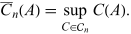
The upper copula capacity of a Borel set  is the supremum of the probabilities assignable
to
 by choosing the dependence between random variables
whose marginal distributions are uniform
on
 . Writing
 for the corresponding set of copula probability measures, it is
 |
(1)
|
The distinction between a copula measure and its joint distribution function is understood (Nelsen 2006, Côté and Wang
2026). The supremum is attained for closed  , but need not be attained for
general Borel sets. This is a monotone, normalized,
subadditive set function; it need not be a measure
or a submodular set function. Componentwise transformations
preserving the uniform distribution preserve
its value under preimages (Côté and Wang 2026).
For a nonempty convex set  , let
 and
 be the infimum and supremum of its
 th coordinate projection. Then
 |
(2)
|
This two-dimensional formula fails in higher dimensions. The regular octahedron  ,
for example, has full coordinate projections but upper copula capacity
 (Côté and Wang 2026).
For positive weights  and
 , the exact lower-tail formula is
 |
(3)
|
where  (Côté and Wang 2026). For a decreasing Borel
set
 , meaning that
 and
 coordinatewise imply
 , one also has
 for
 .
For a bounded nonnegative upper semicontinuous function  , its upper Choquet integral is
 . It is at least
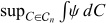 . Equality holds exactly when one
copula simultaneously attains
 for every real
 (Côté and Wang 2026). Thus integration against
the upper capacity can exceed the largest expectation under any single copula.
A finite combinatorial interpretation uses  vertex classes of size
 and a multipartite hypergraph. Partition each coordinate interval
into
 equal parts and let
 be the union of boxes corresponding to the hyperedges. Then
 is the maximum fractional matching size, where weights on hyperedges are nonnegative
and sum to at most 1 at each vertex (Côté and Wang 2026).
