

A copula is a function that joins univariate distribution functions to form multivariate distribution
functions. Writing ![I=[0,1]](/images/equations/Copula/Inline1.svg) ,
a two-dimensional copula is a function
,
a two-dimensional copula is a function  such that
 |
(1)
|
and
 |
(2)
|
for all  , and
, and
 |
(3)
|
for all  such that
  and
and  (Nelsen 2006).
More generally, an  -dimensional
copula
-dimensional
copula  is a joint
distribution function whose marginal distributions
are uniform distributions on
is a joint
distribution function whose marginal distributions
are uniform distributions on  . Given univariate distribution
functions
. Given univariate distribution
functions  ,
...,
,
...,  , the function
 |
(4)
|
is a joint distribution function with the prescribed marginal distributions. Conversely, Sklar's theorem states that every joint distribution function has such a representation. The copula is unique when all the marginal distribution functions are continuous functions (Nelsen 2006). This separates the modeling of dependence from the choice of marginal distributions.
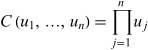
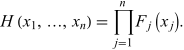
For example, choosing
 |
(5)
|
gives
 |
(6)
|
The resulting random variables are statistically independent. In general, the statistical
distribution with joint distribution
function  is distinct from that with joint distribution
function
is distinct from that with joint distribution
function  ,
whose marginal distributions are uniform
distributions.
,
whose marginal distributions are uniform
distributions.
Statistical distributions constructed from a copula and prescribed marginal distributions,
called copula distributions, are implemented in the Wolfram
Language as CopulaDistribution[ker,
 dist1, dist2, ...
 ], where ker specifies the copula kernel and dist1,
dist2, ... are the prescribed marginal
distributions.
], where ker specifies the copula kernel and dist1,
dist2, ... are the prescribed marginal
distributions.
