


A unicyclic graph is, in the usual literature convention, a connected graph containing exactly one graph cycle (Harary 1994, p. 41). MathWorld and the Wolfram Language GraphData class "Unicyclic" use the broader convention of exactly one graph cycle, allowing disconnected graphs. Under this convention, one connected component contains the unique graph cycle and every other connected component is a tree. For example, a triangle graph together with an isolated vertex is unicyclic in the MathWorld and GraphData convention but not in the connected literature convention.
A connected unicyclic graph is therefore a pseudotree that is not a tree. Equivalently, a connected graph is unicyclic iff its circuit rank, also called its cyclomatic number, is 1. Consequently, a graph is a pseudoforest iff each of its connected components is either a tree or a connected unicyclic graph.
Thus a connected graph that is unicyclic has the same number of edges as vertices.
More generally, a graph with exactly one graph cycle and  connected components satisfies
  .
.
This follows since deleting an edge from the unique graph cycle leaves a forest
with the same number  of connected components and hence
  edges. Conversely, adding
an edge to a forest between
two vertices in the same connected
component creates exactly one graph cycle. In
particular, attaching pendant edges, or more generally
trees, to vertices of a
unicyclic graph preserves unicyclicity.
edges. Conversely, adding
an edge to a forest between
two vertices in the same connected
component creates exactly one graph cycle. In
particular, attaching pendant edges, or more generally
trees, to vertices of a
unicyclic graph preserves unicyclicity.
Truszczyński (1984) conjectured that all connected unicyclic graphs except the cycle graph  with
with  or 2 (mod 4) are graceful
(Gallian 2025, pp. 18-19).
or 2 (mod 4) are graceful
(Gallian 2025, pp. 18-19).
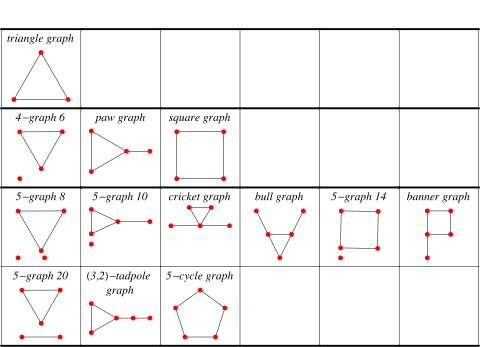
The numbers of unlabeled simple unicyclic graphs in the broader MathWorld and GraphData
convention on  ,
2, ... vertices are 0, 0, 1, 3, 9, 25, 68, 185, ...
(OEIS A236570), the first few of which are
illustrated above.
,
2, ... vertices are 0, 0, 1, 3, 9, 25, 68, 185, ...
(OEIS A236570), the first few of which are
illustrated above.
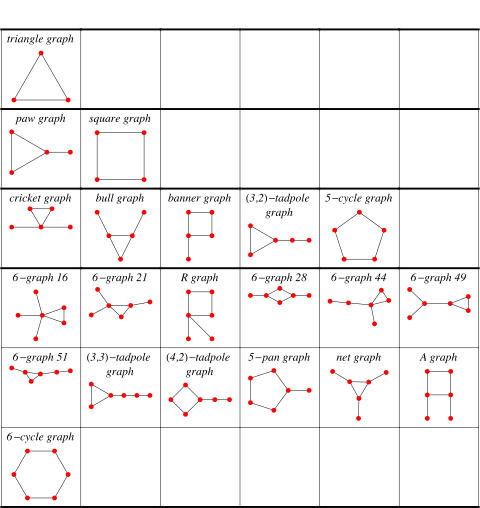
The corresponding numbers in the connected literature convention are 0, 0, 1, 2, 5, 13, 33, 89, ... (OEIS A001429), the first few of which are illustrated above.
Examples of unicyclic classes of graphs include  -caveman graphs, cycle
graphs
-caveman graphs, cycle
graphs  ,
pan graphs, sunlet graphs
,
pan graphs, sunlet graphs  , and tadpole
graphs.
, and tadpole
graphs.
In the connected convention, the triangle graph  is the only nonbipartite unicyclic integral graph
(Braga et al. 2026). The connectedness condition is essential for this wording
under MathWorld's broader convention. Braga et al. (2026) acknowledge Claude
assistance with exploring ideas and checking proofs, and
state that they verified the mathematical content.
is the only nonbipartite unicyclic integral graph
(Braga et al. 2026). The connectedness condition is essential for this wording
under MathWorld's broader convention. Braga et al. (2026) acknowledge Claude
assistance with exploring ideas and checking proofs, and
state that they verified the mathematical content.
