


The Hardy-Littlewood conjectures are two conjectures about the distribution of primes. The first is called the k-tuple conjecture. It states that the asymptotic number of prime constellations can be computed explicitly. A particular case gives the so-called strong twin prime conjecture.
For a fixed positive even number  , write
 for the number of primes
 for which
 is also a prime number. Lee (2026) proved the conditional
asymptotic
 |
where  is the twin primes constant and the product
is over primes dividing
 . The assumption is a uniform two-over-two ratios formula
for the Riemann zeta function with real parts
of the four shifts in
 and imaginary parts bounded in absolute value by
 at height
 , for fixed
 .
The required error is
 for every
 for some fixed
 .
The second Hardy-Littlewood conjecture states that
 |
for all integers  ,
where
 is the prime counting function.
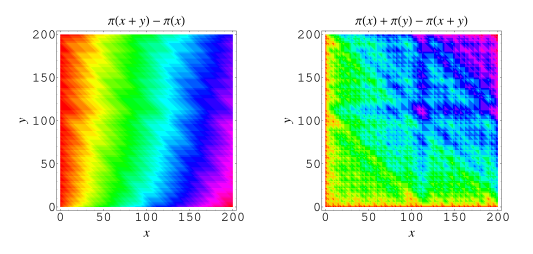
The following table summarizes the first few values of  for integer
 and
 ,
2, .... The values of this function are plotted above.
 | OEIS |  for  ,
2, ... |
| 1 | A010051 | 1, 1, 0, 1, 0, 1, 0, 0, 0, 1, 0, 1, 0, 0, 0, 1, 0, 1, 0, ... |
| 2 | A090405 | 2, 1, 1, 1, 1, 1, 0, 0, 1, 1, 1, 1, 0, 0, 1, 1, 1, 1, 0, ... |
| 3 | A090406 | 2, 2, 1, 2, 1, 1, 0, 1, 1, 2, 1, 1, 0, 1, 1, 2, 1, 1, 0, ... |
The two conjectures are incompatible (Hensley and Richards 1974, Richards 1974).
