


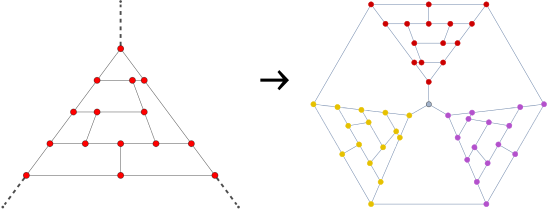
Tutte's fragment (Taylor 1997), also known as the Tutte gadget (Knuth 2025, Problem 27, p. 44), is the 15-node graph illustrated above (Grünbaum 2003, pp. 358-359 and Fig. 17.1.3).
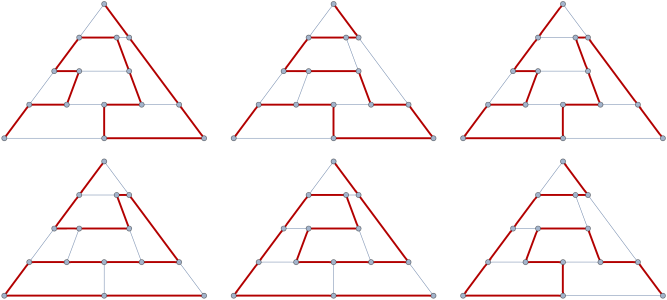
If the graph obtained by adding pendant edges to corners of the triangle is part of a larger graph, then any Hamiltonian path through the graph must pass through the top vertex and one of the lower two. Specifically, it is not possible for it to enter through one of the lower vertices and out the other (Taylor 1997). Tutte (1946) used this fact to join three Tutte fragments (at their tops and sides) into the Tutte graph, the first known counterexample to Tait's Hamiltonian graph conjecture.
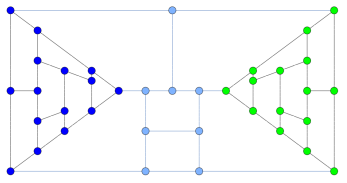
The Tutte fragment was also used by Holton and McKay (1988) to construct the exactly 6 cubic nonhamiltonian polyhedral graphs on 38 vertices by splicing two copies into a pentagonal prism graph, one of which is the Barnette-Bosák-Lederberg graph (cf. Grünbaum 2003, p. 361).
Tutte's fragment is implemented in the Wolfram Language as GraphData["TutteFragment"].
