


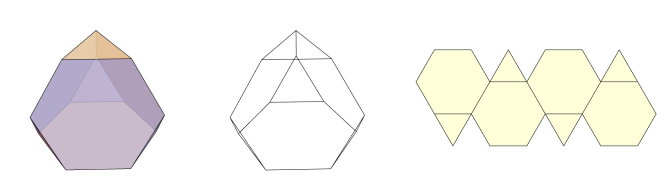

The truncated tetrahedron is the Archimedean solid with faces  . It is also the uniform
polyhedron with Maeder index 2 (Maeder 1997), Wenninger index 6 (Wenninger 1989),
Coxeter index 16 (Coxeter et al. 1954), and Har'El index 7 (Har'El 1993).
It has Schläfli symbol t
 and Wythoff symbol
 . It is illustrated above together with a wireframe
version and a net that can be used for its construction.
The truncated tetrahedron can be constructed by removing four corner regular tetrahedra, each with edge length 1, from a regular tetrahedron of edge length 3. Each cut is parallel to the opposite face.

Removing the same four corners from a regular tetrahedron of edge length 4 instead gives a nonuniform truncation that is a space-filling polyhedron (Damasceno et al. 2012, pp. 610-611). It has four equilateral triangle faces and four equiangular hexagons with alternating edge lengths 1 and 2. The figure shows this solid and a periodic arrangement of congruent copies based on the coordinates given by Pegg (2015). This eight-face space-filler differs from the 16-face triakis truncated tetrahedron, another related space-filling polyhedron.
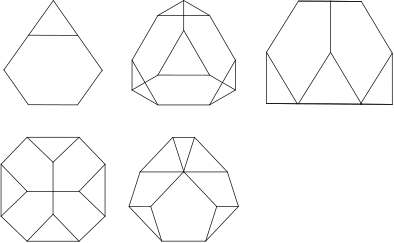
Some symmetric projections of the truncated tetrahedron are illustrated above.
It is implemented in the Wolfram Language as PolyhedronData["TruncatedTetrahedron"] or UniformPolyhedron["TruncatedTetrahedron"]. Precomputed properties are available as PolyhedronData["TruncatedTetrahedron", prop].
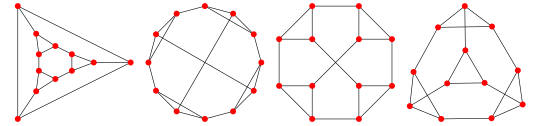
The skeleton of the truncated tetrahedron is the truncated tetrahedral graph, illustrated above in a number of embeddings.
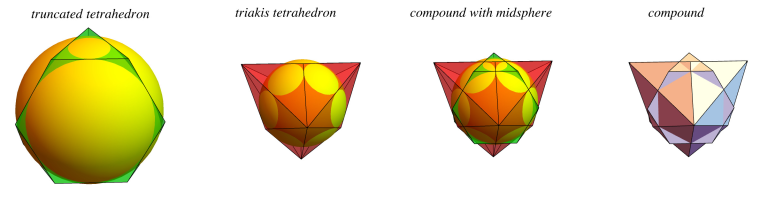
The dual polyhedron of the truncated tetrahedron is the triakis tetrahedron, both of which
are illustrated above together with their common midsphere.
The inradius  of the dual, midradius
 of the solid and dual, and circumradius
 of the solid for unit edge
length (
 ) are
 |  |  |
(1)
|
 |  |  |
(2)
|
 |  |  |
(3)
|
The distances from the center of the solid to the centroids of the triangular and hexagonal faces are given by
 |  |  |
(4)
|
 |  |  |
(5)
|
The surface area and volume are
 |  |  |
(6)
|
 |  |  |
(7)
|
The unit truncated tetrahedron has Dehn invariant
 |  |  |
(8)
|
 |  |  |
(9)
|
 |  |  |
(10)
|
(OEIS A377277), where the first expression uses the basis of Conway et al. (1999, p. 331).

 ." §3.7.1 in
 Pegg, E. Jr. "Tetrahedral Space-Filler." Wolfram Community.
Oct. 19, 2015.