A tritronquée solution is one of five distinguished solutions of Painlevé I, the equation defining the first of the six Painlevé
transcendents,
Each solution is a meromorphic function of the complex variable. Near infinity, the rays for , , divide the complex plane
into five sectors. Crossing one of these boundaries can change exponentially small
terms through the Stokes phenomenon. Generic
solutions have poles accumulating toward all five boundaries,
while a tritronquée is asymptotically free of poles
in four consecutive sectors and therefore admits an asymptotic
series there (Boutroux 1913, 1914). The five choices are related by the fivefold
rotational symmetry for , 1, ..., 4 (Costin et al. 2014).
One real member is selected by as . Under the rescaling and , the equation becomes
The selected solution then satisfies as . Its first real pole occurs
at ,
corresponding to .
More precisely, the approximation satisfies . Adali and Tanveer (2016)
also constructed an explicit piecewise analytic
approximation on a domain avoiding the pole,
with rigorous uniform bounds and for the error and its derivative.
Ribes Metidieri et al. (2026) used this approximation in the analysis of a
slow passage through a fold catastrophe.
Adali, A. and Tanveer, S. "Rigorous Analytical Approximation of Tritronquée Solution to Painlevé-I and the First Singularity."
J. Diff. Eq.261, 3843-3863, 2016. https://doi.org/10.1016/j.jde.2016.06.009.Boutroux,
P. "Recherches sur les transcendantes de M. Painlevé et l'étude
asymptotique des èquations différentielles du second ordre." Ann.
Sci. Ecole Norm. Sup. Ser. 3, 30, 255-375, 1913. https://doi.org/10.24033/asens.661.Boutroux,
P. "Recherches sur les transcendantes de M. Painlevé et l'étude
asymptotique des èquations différentielles du second ordre (suite)."
Ann. Sci. Ecole Norm. Sup. Ser. 3, 31, 99-159, 1914. https://doi.org/10.24033/asens.672.Costin,
O.; Huang, M.; and Tanveer, S. "Proof of the Dubrovin Conjecture and Analysis
of the Tritronquée Solutions of ." Duke Math. J.163, 665-704, 2014. https://doi.org/10.1215/00127094-2429589.Ribes
Metidieri, A.; Bonga, B.; Krishnan, B.; and Jaramillo, J. L. "Universality
in the Transition from Inspiral to Plunge: High-Accuracy Analytic Solutions and Catastrophe
Theory." 11 Jun 2026. https://arxiv.org/abs/2606.13786.


 . Near infinity, the rays
  for
for  ,
,  ,
,  divide the complex plane
into five sectors. Crossing one of these boundaries can change exponentially small
terms through the Stokes phenomenon. Generic
solutions have poles accumulating toward all five boundaries,
while a tritronquée is asymptotically free of poles
in four consecutive sectors and therefore admits an asymptotic
series there (Boutroux 1913, 1914). The five choices are related by the fivefold
rotational symmetry
divide the complex plane
into five sectors. Crossing one of these boundaries can change exponentially small
terms through the Stokes phenomenon. Generic
solutions have poles accumulating toward all five boundaries,
while a tritronquée is asymptotically free of poles
in four consecutive sectors and therefore admits an asymptotic
series there (Boutroux 1913, 1914). The five choices are related by the fivefold
rotational symmetry  for
for  , 1, ..., 4 (Costin et al. 2014).
 as
as  . Under the rescaling
  and
and  , the equation becomes

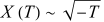 as
as  . Its first real pole occurs
at
. Its first real pole occurs
at  ,
corresponding to
,
corresponding to  .
More precisely, the approximation
.
More precisely, the approximation  satisfies
  . Adali and Tanveer (2016)
also constructed an explicit piecewise analytic
approximation on a domain avoiding the pole,
with rigorous uniform bounds
. Adali and Tanveer (2016)
also constructed an explicit piecewise analytic
approximation on a domain avoiding the pole,
with rigorous uniform bounds  and
and  for the error and its derivative.
Ribes Metidieri et al. (2026) used this approximation in the analysis of a
slow passage through a fold catastrophe.
for the error and its derivative.
Ribes Metidieri et al. (2026) used this approximation in the analysis of a
slow passage through a fold catastrophe.

 ." Duke Math. J. 163, 665-704, 2014.