


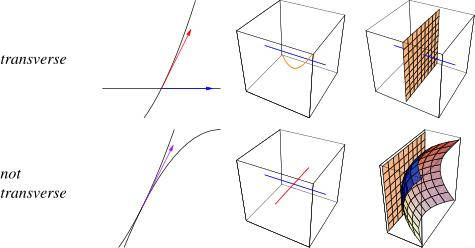
A transversal intersection of two submanifolds  and
 in an ambient manifold
 is one for which, for all
 ,
 |
where the vector addition is in  , and
 denotes the tangent space
of
 at
 .
If two submanifolds do not intersect,
then they are automatically transversal. For example, two curves
in
 are transversal only if they do not intersect at
all. When
 and
 meet transversally,
 is a smooth submanifold
of the expected dimension
 .
In some sense, two submanifolds "ought" to intersect transversally and, by Sard's theorem, any intersection can be perturbed to be transversal. Intersection in homology only makes sense because an intersection can be made to be transversal.
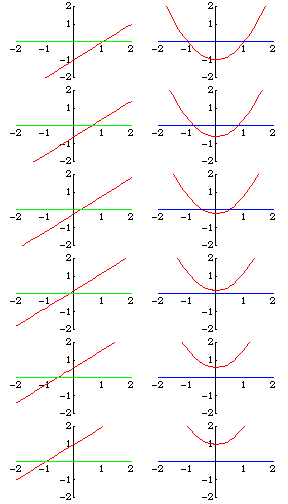
Transversality is a sufficient condition for an intersection to be stable after a perturbation. For example, the lines  and
 intersect transversally, as do the perturbed lines
 ,
and they intersect at only one point.
However,
 does not intersect
 transversally. It intersects
in one point, while
 intersects in either
zero or two points, depending on whether
 is positive or negative.
When  ,
then each point of a transversal intersection is an isolated point. If the three spaces
have a vector space orientation, then
the transversal condition means it is possible to assign a sign to the intersection.
If
 are an oriented vector basis for
 and
 are an oriented vector
basis for
 ,
then the intersection is
 if
 is oriented in
 and
 otherwise.
More generally, two smooth maps  and
 are transversal if whenever
 then
 .
