

The transfer-matrix method is an enumeration method that encodes allowable transitions among finitely many states by a matrix. A state records the boundary information needed to extend a partial object. For a fixed number of states, repeated extension becomes matrix multiplication (Stanley 1999).
Let  be the total weight of allowed transitions from state
 to state
 , with weights in a field.
If the column vectors
 and
 specify initial and terminal weights, then the total weight
after
 transitions is
 |
where  denotes the transpose of
 . The ordinary generating
function is
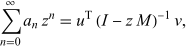 |
where  is the identity matrix. The inverse is interpreted
as a formal power series. Since
 has fixed finite size, this expression is a rational
function of
 ,
and the coefficients satisfy a constant-coefficient
linear recurrence equation.
The method also counts walks in a directed graph, with  its weighted adjacency matrix. For bounded-width
combinatorial constructions, the states can record connections across a moving boundary.
This approach gives generating functions for
knight's tours on fixed-width knight graphs (Elkies
and Stanley 2003).
