The Thomae function (also called Thomae's function, the popcorn function, or the modified Dirichlet function) is defined for a real number
(1)
The Thomae function is continuous at every irrational number and discontinuous at every rational
number . It nevertheless has a Riemann integral
on every interval that is bounded, and the value is
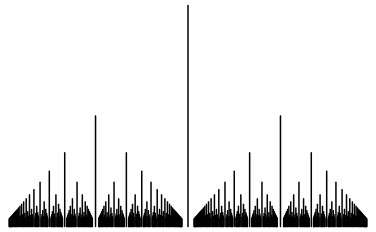
zero. The function graph illustrated above is therefore
dense in spikes, but only finitely many spikes exceed any fixed positive height on
such an interval.
When viewed from a corner along the line quadrant
of Euclid's orchard turns into the function
graph of the Thomae function (Gosper). The name "ruler function" is
also sometimes applied to the Thomae function, but it should not be confused with
the integer-sequence ruler function .
See also Dirichlet Function ,
Euclid's Orchard ,
Irrational Number ,
Rational
Number ,
Riemann Integral ,
Ruler
Function
Explore with Wolfram|Alpha
References Abbott, S. Understanding Analysis, 2nd ed. https://doi.org/10.1007/978-1-4939-2712-8 . Ballone,
F. A. "On Volterra Spaces." Master's thesis. Youngstown, OH: Youngstown
State University, Jun. 2010. Beanland, K.; Roberts, J. W.;
and Stevenson, C. "Modifications of Thomae's Function and Differentiability."
Amer. Math. Monthly 116 , 531-535, 2009. https://doi.org/10.1080/00029890.2009.11920968 . Dixon,
R. Mathographics. Referenced on Wolfram|Alpha Thomae Function
Cite this as:
Weisstein, Eric W. "Thomae Function."
From MathWorld https://mathworld.wolfram.com/ThomaeFunction.html
Subject classifications


 by
by

 in normal perspective, a quadrant
of Euclid's orchard turns into the function
graph of the Thomae function (Gosper). The name "ruler function" is
also sometimes applied to the Thomae function, but it should not be confused with
the integer-sequence ruler function.
in normal perspective, a quadrant
of Euclid's orchard turns into the function
graph of the Thomae function (Gosper). The name "ruler function" is
also sometimes applied to the Thomae function, but it should not be confused with
the integer-sequence ruler function.
