


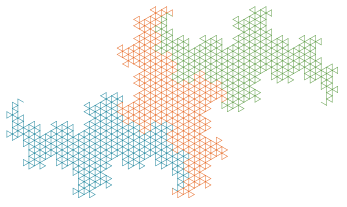
The terdragon is a self-similar fractal curve on the triangular grid
introduced by Davis and Knuth (1970). It is a ternary relative of the dragon
curve: its recursive construction uses three copies, shown in different colors
above, where the usual dragon curve uses two (Davis
and Knuth 1970). It can be generated as a Lindenmayer
system with initial string "F",
replacement rule "F" -> "F+F-F", and angle  .
.
Using coordinates on the triangular grid with basis vectors meeting at  , the
, the  -coordinates of successive
points begin 0, 1, 0, 1, 0, 0,
-coordinates of successive
points begin 0, 1, 0, 1, 0, 0,  , 0,
, 0,  ,
... (OEIS A349040), and the
,
... (OEIS A349040), and the  -coordinates begin 0, 0, 1,
1, 2, 1, 2, 2, 3, ... (OEIS A349041).
-coordinates begin 0, 0, 1,
1, 2, 1, 2, 2, 3, ... (OEIS A349041).
After  replacements, the approximant consists
of
replacements, the approximant consists
of  equal line
segments. With the initial segment from 0 to 1 in the complex
plane, scaling the
equal line
segments. With the initial segment from 0 to 1 in the complex
plane, scaling the  th approximant by
  and rotating it by
  fixes its endpoints and gives a
limiting curve of Hausdorff
dimension 2. Complete triangular folding curves extend to coverings of the triangular grid in which each edge is traversed exactly
once. Rounding the angles at the vertices makes the curves disjoint
(Oger 2023).
fixes its endpoints and gives a
limiting curve of Hausdorff
dimension 2. Complete triangular folding curves extend to coverings of the triangular grid in which each edge is traversed exactly
once. Rounding the angles at the vertices makes the curves disjoint
(Oger 2023).

 Pegg, E. Jr. Mathematical Games. Episode 16: "Space-Filling Curves."
Apr. 18, 2024.
Pegg, E. Jr. Mathematical Games. Episode 16: "Space-Filling Curves."
Apr. 18, 2024.