which is associated with a story told about Ramanujan by G. H. Hardy (Hofstadter 1989, Kanigel 1991, Snow 1993).
This property of 1729 was mentioned by the character Robert the sometimes insane mathematician, played by Anthony Hopkins, in the 2005 film Proof.
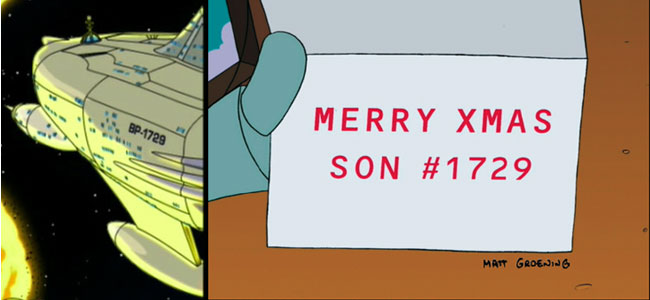
It was also part of the designation of the spaceship Nimbus BP-1729 appearing in
Season 2 of the animated television series Futurama episode DVD 2ACV02 (Greenwald;
left figure), as well as the robot character Bender's serial number, as portrayed
in a Christmas card in the episode Xmas Story (Volume 2 DVD, Georgoulias et
al. 2004; right figure).
However, this property was also known as early as 1657 by Frénicle de Bessy (Berndt and Bhargava 1993, Guy 1994). Leech (1957) found
(4)
(5)
(6)
(7)
Rosenstiel et al. (1991) found
(8)
(9)
(10)
(11)
(12)
Wilson (1999) found
(13)
(14)
(15)
(16)
(17)
(18)
The first few taxicab numbers are therefore 2, 1729, 87539319, 6963472309248, 48988659276962496,
... (OEIS A011541).
Hollerbach (2008) reported that the sixth taxicab number is
(19)
(20)
(21)
(22)
(23)
(24)
(25)
Calude et al. (2003) had previously given probabilistic evidence for this
value.
Hardy and Wright (1979, Theorem 412) show that the number of distinct unordered representations as a sum of two cubes of positive
integers can be made arbitrarily large.
Sloane defines a slightly different type of taxicab numbers, namely numbers which are sums of two cubes of positive
integers in two or more distinct unordered ways, the first few of which are 1729,
4104, 13832, 20683, 32832, 39312, 40033, 46683, 64232, ... (OEIS A001235).


 th
taxicab number
 ,
for a positive integer
 , is the smallest number representable in at least
 distinct unordered ways as a sum of two cubes
of positive integers. The numbers derive their
name from the Hardy-Ramanujan number





 : Mathematics in the Year 3000." Math Horizons,
12-15, Apr. 2004.Greenwald, S. "Dr. Sarah's Futurama
 --Mathematics in the Year 3000."
 ." Bull. Inst. Math.
Appl. 27, 155-157, 1991.Silverman, J. H. "Taxicabs
and Sums of Two Cubes." Amer. Math. Monthly 100, 331-340, 1993.Sloane,
N. J. A. Sequences