

The table of marks of a finite group  records the numbers of group
fixed points for the transitive group actions
of
records the numbers of group
fixed points for the transitive group actions
of  on cosets
of its subgroups. Let
on cosets
of its subgroups. Let  ,
,  ,
...,
,
...,  be representatives of the conjugacy classes of
subgroups of
be representatives of the conjugacy classes of
subgroups of  .
The table of marks is the
.
The table of marks is the  matrix
  with
with
 |
Thus  is the number of fixed points of the subgroup
  in the transitive
group action of
in the transitive
group action of  on the right cosets of
  (Burnside 1955).
If the subgroup classes are ordered compatibly with containment after replacing subgroups by conjugate
subgroups, the table is a lower triangular
matrix. Its  th
diagonal entry is the subgroup
index
th
diagonal entry is the subgroup
index ![[N_G(H_i):H_i]](/images/equations/TableofMarks/Inline14.svg) of
of  in its normalizer,
so the table is a nonsingular matrix. Since
every transitive permutation action of
in its normalizer,
so the table is a nonsingular matrix. Since
every transitive permutation action of  is equivalent to a group action
on the cosets of a subgroup, the nonsingularity of the
table allows the multiplicities of the transitive constituents of a finite
is equivalent to a group action
on the cosets of a subgroup, the nonsingularity of the
table allows the multiplicities of the transitive constituents of a finite  -set to be recovered from its counts
of group fixed points. The table also encodes
containment information among conjugacy classes
of subgroups (GAP).
-set to be recovered from its counts
of group fixed points. The table also encodes
containment information among conjugacy classes
of subgroups (GAP).
For example, using the class order  ,
,  ,
,
 ,
,  , the table of marks of the symmetric
group
, the table of marks of the symmetric
group  is
is
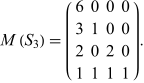 |
Tables of marks were introduced by Burnside and are consequently also called Burnside matrices (Burnside 1955, GAP).
