TOPICS
Search

Supercritical Ten Martini Problem


The supercritical Ten Martini problem asks whether the operator spectrum of a one-frequency quasiperiodic Schrödinger operator is Cantor in the region of positive Lyapunov exponent (Ge et al. 2026). The operator acts on square-summable sequences by

 (H_(v,alpha,theta)u)_n=u_(n+1)+u_(n-1)+v(theta+nalpha)u_n,

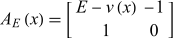
where v:R/Z->R is a nonconstant real analytic function, alpha is irrational, and theta in R/Z. Its operator spectrum Sigma_(v,alpha) is independent of theta. For the transfer matrix A_E(x)=[E-v(x) -1; 1 0], put

 L(E)=lim_(N->infty)1/Nint_0^1ln||A_E(x+(N-1)alpha)...A_E(x)||dx.

Ge et al. (2026) report that Sigma_(v,alpha) intersection O, where O={E:L(E)>0}, is a relatively perfect set with empty interior whenever the intersection is nonempty. It is closed relative to O, so it need not be a compact Cantor set in the whole real line. In particular, the entire operator spectrum is a Cantor set if L(E)>0 throughout it. For every such v, this occurs after multiplication by a sufficiently large coupling constant (Sorets and Spencer 1991). The almost Mathieu operator is the special case v(x)=2lambdacos(2pix) with lambda!=0, whose Cantor-spectrum result is the Ten Martini theorem (Avila and Jitomirskaya 2009).



See also

Almost Mathieu Operator, Cantor Set, Operator Spectrum

Explore with Wolfram|Alpha

References

Avila, A. and Jitomirskaya, S. "The Ten Martini Problem." Ann. Math. 170, 303-342, 2009. https://doi.org/10.4007/annals.2009.170.303.Ge, L.; Jitomirskaya, S.; and You, J. "The Supercritical Ten Martini Problem." 9 Nov 2026. https://arxiv.org/abs/2611.13068v1.Sorets, E. and Spencer, T. "Positive Lyapunov Exponents for Schrödinger Operators with Quasi-Periodic Potentials." Commun. Math. Phys. 142, 543-566, 1991. https://doi.org/10.1007/BF02099100.

Cite this as:

Weisstein, Eric W. "Supercritical Ten Martini Problem." From MathWorld--A Wolfram Resource. https://mathworld.wolfram.com/SupercriticalTenMartiniProblem.html

Subject classifications