


A split graph is a finite simple graph whose vertices can be partitioned into a clique and an independent vertex set, with either part allowed to be empty.
Equivalently, it is a chordal graph whose graph complement is also chordal (Royle 2000). Royle
(2000) also proved that there is a one-to-one
correspondence between split graphs on  vertices up to graph
isomorphism and the minimal covers of an
 -element set up
to permutations of its elements.
Classes of graphs that are split include complete  , empty
 , star,
and sun graphs formed from a clique
and an independent vertex set.
Since all chordal graphs are perfect, so too are all split graphs.
Let  be the degree sequence of a finite simple
graph on
 vertices, and let
 be the largest value of
 such that
 . Then the graph is a split
graph iff
 |
Furthermore, for a graph satisfying this condition, the vertices corresponding to the first  degrees in the degree
sequence correspond to a maximum clique and
the remainder to an independent vertex set
(Golumbic 1980, Hammer and Simeone 1981).
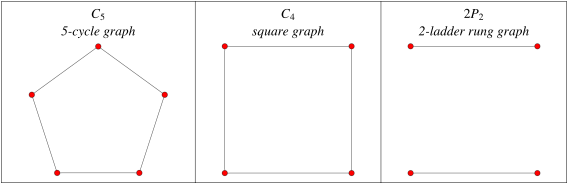
A graph is a split graph iff it does not contain any of the graphs  ,
 ,
and
 as a forbidden
induced subgraph, where
 is a cycle graph,
 is a graph complement,
and
 is the 2-ladder
rung graph (Mukhopadhyay et al. 2023).
The numbers of simple split graphs up to graph isomorphism on  , 2, ... vertices
are given by 1, 2, 4, 9, 21, 56, 164, 557, 2223, 10766, 64956, 501696, ... (OEIS
A048194).
Threshold graphs form a subclass of split graphs characterized by additionally excluding  as a vertex-induced
subgraph. Equivalently, a threshold graph
can be built by successively adding an isolated vertex
or a graph vertex adjacent to every existing graph
vertex (Li and Liu 2026, p. 2).
For each fixed positive integer  , a graph intersection
of
 split graphs has chromatic
number at most
 ,
where
 is its clique number. More general Boolean
combinations of graphs formed from
 split graphs have chromatic
number at most
 (Adenwalla et al. 2026, pp. 29-30).
