

The spectral radius of an  matrix
 with complex or real
elements and eigenvalues
 , ...,
 is
 |
i.e., the largest absolute value (or complex modulus) of its eigenvalues.
The spectral radius of a finite graph is defined as the largest absolute value of its graph spectrum, i.e., the largest absolute value of the graph eigenvalues (eigenvalues of the adjacency matrix) .
Shearer (1989) showed that for every real number  there is a
sequence of finite caterpillar
trees whose spectral radii tend to
 . Consequently, the spectral
radii of finite graphs, and
even of finite trees, are dense in the interval
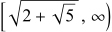 .
In a MathOverflow discussion, Vaughan Jones asked whether graph spectral radii are dense in any interval. Jonas Meyer referred him to related results in Coxeter Graphs and Towers of Algebras, a book Jones had coauthored. Jones acknowledged forgetting material in the book, while noting that Shearer's result had not yet been published when the book was completed (Jones and Meyer 2010).
For a bounded operator  on a nonzero complex Banach
space, the spectral radius is the maximum absolute
value of its operator spectrum. The spectral
radius formula gives
 .
Thus a quasinilpotent operator is one
with spectral radius zero.
