

The sinh-Poisson equation is the nonlinear elliptic partial differential equation
 |
(1)
|
where  is a constant parameter
and
is a constant parameter
and  is the Laplacian (Ting et al. 1987; Zwillinger
1997, p. 135). In two-dimensional Cartesian
coordinates,
is the Laplacian (Ting et al. 1987; Zwillinger
1997, p. 135). In two-dimensional Cartesian
coordinates,  .
Since
.
Since  ,
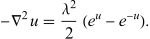
the equation can also be written as
,
the equation can also be written as
 |
(2)
|
The constant function  is a solution. Since
  , if
, if  is a solution then so is
  . In particular, homogeneous boundary
conditions preserve this symmetry. Since
. In particular, homogeneous boundary
conditions preserve this symmetry. Since  as
as  , replacing
  by its first-order linear
approximation gives the Helmholtz
differential equation
by its first-order linear
approximation gives the Helmholtz
differential equation
 |
(3)
|
The Laplacian form distinguishes the sinh-Poisson equation from the sinh-Gordon equation, which in the
convention used here has  .
.
Solutions of the form  satisfy an ordinary
differential equation. Multiplication by
satisfy an ordinary
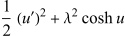
differential equation. Multiplication by  and integration give
 |  |  |
(4)
|
 |  |  |
(5)
|
where  is a constant. For real
  and
and  , these solutions are periodic
functions that range between the two roots of
, these solutions are periodic
functions that range between the two roots of 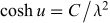 , and the resulting quadrature
is an elliptic integral.
, and the resulting quadrature
is an elliptic integral.
The nonlinear boundary value problem need not have a unique solution. For homogeneous Dirichlet
boundary conditions on a square, McDonald (1974) computed
six distinct solutions for the same value of  . Exact solutions on a square,
as well as doubly periodic functions satisfying
the equation, can be expressed using Jacobi
elliptic functions. One class has the form
. Exact solutions on a square,
as well as doubly periodic functions satisfying
the equation, can be expressed using Jacobi
elliptic functions. One class has the form ![u(x,y)=4tanh^(-1)[X(x)Y(y)]](/images/equations/Sinh-PoissonEquation/Inline26.svg) , where
, where  denotes the inverse
hyperbolic tangent, and
denotes the inverse
hyperbolic tangent, and  and
and  are one-variable functions whose
parameters are constrained by the equation (Ting et
al. 1987, Chow et al. 2003).
are one-variable functions whose
parameters are constrained by the equation (Ting et
al. 1987, Chow et al. 2003).
