

A simple group is a nontrivial group whose only normal subgroups are the trivial subgroup of order
one and the improper subgroup consisting of the entire
original group (Lang 2002). Simple groups include the infinite
families of alternating groups of degree  , cyclic groups
of prime order, Lie-type
groups, and the 26 sporadic groups.
Since every subgroup of an Abelian group is normal, an Abelian simple group has no proper nontrivial subgroups. Any nonidentity element must therefore generate the whole group, so the group is cyclic. An infinite cyclic group has proper nontrivial subgroups, and a finite cyclic group of composite order has a subgroup of each divisor order. Thus the Abelian simple groups are precisely the cyclic groups of prime order.
In fact, the classification theorem of finite groups states that finite simple groups can be classified completely into these five types:
1. Cyclic groups of prime group order,
2. Alternating groups of degree at least five,
4. Lie-type twisted Chevalley groups or the Tits group, and
5. The sporadic groups.
Burnside's conjecture states that every non-Abelian finite simple group has even group order.
The group order together with the scalar statistic
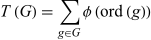 |
does not determine whether a finite group is simple (van Doorn et al. 2026). Here  is the totient function
and
 is the order
of the element
 .
A counterexample is the projective
special unitary group
 and
 .
Both have group order 6048 and
 ,
but
 is simple and
 is not. Here
 denotes a cyclic group of
order
 , and
 is the symmetric group
on four letters. The expression for
 uses a group direct product
and a semidirect product in which a generator
of
 acts on
 by multiplication by 3 modulo 7. The assertion concerns
only the scalar sum
 , rather than the full set
of element orders.
The authors report that Aristotle discovered the proof
and formalized it in Lean.
The finite (cyclic) group  forms the subject for the humorous
a capella song "Finite
Simple Group (of Order 2)" by the Northwestern University mathematics department
a capella group "The Klein Four."
Renteln and Dundes (2005) give a (rather bad) mathematical joke involving simple groups:
Q: What is purple and all of its offspring have been committed to institutions? A: A simple grape: it has no normal subgrapes.
