

The Shannon-Hartley theorem gives the channel capacity  of a band-limited channel with additive
white Gaussian noise as
of a band-limited channel with additive
white Gaussian noise as
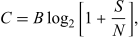 |
where  is the bandwidth in hertz,
  is the average power of the
signal, and
is the average power of the
signal, and  is the average power of the noise in that bandwidth.
The channel capacity is measured in bits per
second.
is the average power of the noise in that bandwidth.
The channel capacity is measured in bits per
second.
The theorem states an upper bound on reliable communication rather than a rate attained by every coding scheme. Rates below  can be approached with arbitrarily small error by sufficiently
long codes, whereas rates above
can be approached with arbitrarily small error by sufficiently
long codes, whereas rates above  cannot. Writing
  as the signal-to-noise
ratio shows the tradeoff between bandwidth and
signal quality.
as the signal-to-noise
ratio shows the tradeoff between bandwidth and
signal quality.
