

Additive white Gaussian noise is a stochastic noise model in which a signal is combined additively with a stochastic process having zero mean and constant power spectral density (expected average power per unit frequency). "White" means that distinct frequency bands contain equal expected noise average power per unit bandwidth, and "Gaussian" means that every finite collection of noise samples has a multivariate normal distribution.
For a continuous-time model with two-sided power spectral density  ,
the idealized autocorrelation is
,
the idealized autocorrelation is
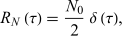 |
where  is the delta function. Additive white Gaussian
noise is the channel model used in the Shannon-Hartley
theorem.
is the delta function. Additive white Gaussian
noise is the channel model used in the Shannon-Hartley
theorem.
