

The channel capacity of a communication channel, meaning a mathematical model that associates possible outputs with each input, is the supremum
of the rates at which information can be transmitted with arbitrarily small error.
For a discrete memoryless channel having input  and output
  , it is
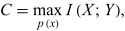 |
where  is the mutual information and the maximum is
taken over input statistical distributions
is the mutual information and the maximum is
taken over input statistical distributions  .
.
For an additive white Gaussian noise channel constrained to bandwidth  , average signal power
  , and average noise power
  , the Shannon-Hartley
theorem gives
, the Shannon-Hartley
theorem gives  .
This operational channel capacity is distinct from the graph-theoretic Shannon
capacity, which describes zero-error communication.
.
This operational channel capacity is distinct from the graph-theoretic Shannon
capacity, which describes zero-error communication.
