

A scattering amplitude is a quantity taking values in the complex numbers that describes how an incoming state contributes to a specified outgoing
state in scattering theory. For example, a three-dimensional
wave with incident plane wave  can have the far-field form
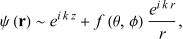 |
where the complex function  is the scattering amplitude in the direction
  . Its magnitude and phase encode
the strength and phase shift of the outgoing wave. In quantum field theory, scattering
amplitudes similarly give complex coefficients for transitions between specified
incoming and outgoing particle states. The canonical
form of an amplituhedron encodes an integrand
for certain such amplitudes.
. Its magnitude and phase encode
the strength and phase shift of the outgoing wave. In quantum field theory, scattering
amplitudes similarly give complex coefficients for transitions between specified
incoming and outgoing particle states. The canonical
form of an amplituhedron encodes an integrand
for certain such amplitudes.
