

The name root linear coefficient theorem is used here for the following consequence of Vieta's formulas. For a polynomial  of degree
 with
 and roots
 , ...,
 counted with multiplicity,
 |
In particular, when  ,
the sum of the reciprocals of the roots
is the negative of the linear coefficient.
The identity follows by comparing linear coefficients in the factorization
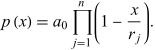 |
The corresponding assertion does not hold for an arbitrary Maclaurin series. For example, the exponential function  has constant and linear coefficients equal to 1 but
has no roots. Applications to infinite
products require a justified product representation and coefficient
comparison.
