

The Riordan number  , for a nonnegative
integer
 , is the number of set
partitions of
 points placed on a circle such that every set
block contains at least two points and the convex
hulls of distinct blocks are disjoint (Bernhart 1999). The first few Riordan
numbers are 1, 0, 1, 1, 3, 6, 15, 36, 91, 232, 603, 1585, ... (OEIS A005043).
They are also called ring numbers (Bernhart 1999).
The Riordan numbers satisfy the recurrence relation
 |
(1)
|
for  , with
 and
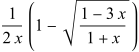
 . Their generating
function is
 |  |  |
(2)
|
 |  |  |
(3)
|
 |  |  |
(4)
|
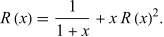
It obeys the functional equation
 |
(5)
|
The Catalan number  is given by (Bernhart 1999)
 |
(6)
|
Indeed,  counts all noncrossing set partitions of the
 points. There are
 ways to choose the
 points belonging to set blocks of size at least two
and
 ways to partition the chosen points as in the definition of
 . Each remaining point forms a set
block by itself.
If  is the
 th
Motzkin number, then
 |
(7)
|
Equivalently,  counts ordered rooted trees with
 edges in which no vertex
has exactly one child (Bernhart 1999).
