

For a function  , noninteger order
  , and positive integer
  with
with 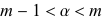 , the left-sided Riemann-Liouville fractional
derivative with lower terminal
, the left-sided Riemann-Liouville fractional
derivative with lower terminal  is defined by
 |
(1)
|
where  is the Riemann-Liouville
operator of fractional integration. Thus,
the Riemann-Liouville fractional derivative performs fractional
integration before ordinary differentiation.
For integer order
is the Riemann-Liouville
operator of fractional integration. Thus,
the Riemann-Liouville fractional derivative performs fractional
integration before ordinary differentiation.
For integer order  , it is defined to be the ordinary
  th derivative. The special case
 is a semiderivative.
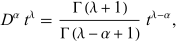
For lower terminal  , the Riemann-Liouville fractional derivative of a power
function is
, the Riemann-Liouville fractional derivative of a power
function is
 |
(2)
|
where  is the gamma function.
This formula holds for
is the gamma function.
This formula holds for  ,
,  , and values for which the expression exists. In particular,
for a positive noninteger
, and values for which the expression exists. In particular,
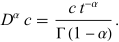
for a positive noninteger  , the Riemann-Liouville fractional derivative of the constant function
  is
is
 |
(3)
|
This is generally nonzero, in contrast to the Caputo fractional derivative of a constant, which is zero.
The fractional derivative of the Et-function satisfies
 |
(4)
|
for  and
and  .
.
Riemann-Liouville fractional integrals satisfy the semigroup property
 |
(5)
|
for  . The analogous function
composition rule for fractional derivatives
does not hold without additional hypotheses; in general,
. The analogous function
composition rule for fractional derivatives
does not hold without additional hypotheses; in general,
 |
(6)
|
Boundary terms or suitable boundary conditions on  determine when a derivative composition law is valid.
For lower terminal  , the Riemann-Liouville fractional derivative is implemented
in the Wolfram Language as FractionalD[f,
, the Riemann-Liouville fractional derivative is implemented
in the Wolfram Language as FractionalD[f,
 x,
alpha
x,
alpha ].
].
