

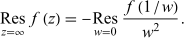
The residue at infinity of a function  that is analytic for
 is the complex residue at
 of the one-form obtained from
 by the change of variables
 . Since
 , this gives
 |
(1)
|
The factor  is essential. The residue at infinity is generally different from the complex
residue of
 alone at
 (Gautam 2020, p. 2).
Equivalently, if  is the counterclockwise circle
 with
 , then
 |
(2)
|
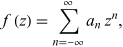
The minus sign corresponds to a clockwise contour surrounding the finite part of the complex plane. If the exterior Laurent series is
 |
(3)
|
then the residue at infinity is  . For example,
 |  |  |
(4)
|
 |  |  |
(5)
|
The first function is analytic at infinity when considered as a function
on the Riemann sphere, although its one-form  has a pole
there.
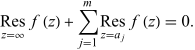
If  has only finitely many finite isolated singularities
 , ...,
 and is analytic elsewhere
in the complex plane, the residue
theorem gives
 |
(6)
|
The finite singularities may be poles or essential singularities.
