

A regular polytope is a polytope whose symmetry group acts transitively on its flags, where a flag
contains one face of each dimension
in a maximal chain. Equivalently, any flag can be carried
to any other by a symmetry of the polytope.
For a convex regular  -polytope, the Schläfli
symbol
 records its recursive structure. Its facets have symbol
 , and its vertex
figures have symbol
 . The symbols of a dual pair are obtained by
reversing the sequence.
The convex regular polytopes are completely classified up to similarity (Coxeter
1973; Heckman 2018, pp. 17-19). In two dimensions there is a regular
polygon  for every integer
 . In three dimensions there are the five Platonic
solids, with symbols
 ,
 ,
 ,
 , and
 , corresponding to the tetrahedron,
cube, octahedron, dodecahedron,
and icosahedron.
In four dimensions there are six convex regular polychora. The pentatope  , tesseract
 , and 16-cell
 belong to the simplex, hypercube, and cross polytope
families, respectively. The remaining three are the 24-cell
 , 120-cell
 , and 600-cell
 . The pentatope
and 24-cell are self-dual, while the tesseract
and 16-cell, and the 120-cell
and 600-cell, form dual pairs.
In every dimension  ,
only three convex regular polytopes
remain. Their symbols are
 for the simplex,
 for the hypercube,
and
 for the cross polytope, with
 entries in each symbol. The simplex
is self-dual, and the hypercube and cross
polytope are dual to each other. This classification concerns convex polytopes; allowing star figures also gives the Kepler-Poinsot
polyhedra and the nonconvex regular polychora.
The restriction on the possible symbols can be understood from the reflections associated with a flag. The centers of its faces,
together with the center of the polytope, form a simplex whose bounding reflection planes
through the center of the polytope have unit normal
vectors. Their Gram matrix  is a tridiagonal matrix
with
 ,
 , and
all other entries zero. Since these normal vectors
are linearly independent,
 is positive definite.
If
 is the determinant of its leading
 block, then
 |
(1)
|
where  .
All these determinants must be positive (Heckman
2018, pp. 18-19).
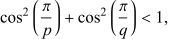
For a three-dimensional symbol  , this gives
 |
(2)
|
which allows exactly the five symbols above for integers  . In four dimensions the corresponding
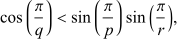
condition is
 |
(3)
|
which allows exactly the six convex regular polychora.
The same calculation explains why the exceptional cases stop. In dimension at least 5, a label 5, a label 4 in an interior position, or two labels 4 produce a subset
of these normal vectors whose Gram
matrix has a nonpositive determinant. Thus the
only possibilities are all labels 3, or a single label 4 at either end. These are
precisely the three families above. For all labels 3,  , while for a single end label 4,
 , so both constructions remain admissible in every
dimension (Heckman 2018, p. 19).
