

A reflection coefficient is the complex ratio of a reflected wave amplitude to the corresponding incident wave amplitude. For voltage waves on a transmission line,
let  travel toward a load of impedance
  and let
  travel away from it. If the line has real positive characteristic
impedance
travel away from it. If the line has real positive characteristic
impedance  ,
then the voltage reflection coefficient at the load is
,
then the voltage reflection coefficient at the load is
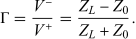 |
The complex modulus  is the reflected-to-incident voltage-amplitude ratio,
while the complex argument of
is the reflected-to-incident voltage-amplitude ratio,
while the complex argument of  is the phase shift on reflection. For a lossless line,
the reflected-to-incident power ratio is
is the phase shift on reflection. For a lossless line,
the reflected-to-incident power ratio is  . A Smith chart represents
 while simultaneously displaying the corresponding normalized load impedance (Pozar
2012).
while simultaneously displaying the corresponding normalized load impedance (Pozar
2012).
