

For a directed graph with vertices  ,
 ,
 , the reachability matrix
 records whether one graph vertex
can be reached from another along a directed graph path.
With zero-length paths included, its entries are
 |
(1)
|
In particular,  for every
 .
This matrix represents the reflexive
closure of the transitive closure of the
binary relation defined by the directed edges.
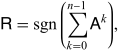
If  is the adjacency matrix, with
 recording edges directed
from
 to
 ,
then
 |
(2)
|
where  is the identity matrix and the sign
function is applied to each entry separately. The powers count directed walks,
and a reachable pair of distinct vertices always
has a graph path of length at most
 . Other conventions require positive-length directed walks;
under those conventions, a diagonal entry is 1 only
when its graph vertex belongs to a directed graph
cycle.
In control theory, "reachability matrix" also denotes the controllability matrix of a finite-dimensional linear time-invariant system, whose column space consists of the states reachable from the zero state.
